
La ración más barata para tu ganado, del corral a la utilidad
The cheapest ration for your cattle, from the pen to the profit
Una guía práctica para formular, mezclar, costear y medir la huella de la ración de tu engorda con RatioBos, explicada con un caso real de Jalisco de principio a fin.
A practical guide to formulating, mixing, costing and measuring the footprint of your feedlot ration with RatioBos, explained through one real case from Jalisco, start to finish.
Hay otra guía para investigación y docencia: el Instructivo del Científico.There is a companion guide for research and teaching: the Scientist Guide.
Cómo usar este instructivo
How to use this guide
Para quién es, cómo está organizado y qué significa cada señal que encontrarás en las páginas.
Who it is for, how it is organised and what each sign on the page means.
Este instructivo es para quien decide qué comen los bovinos de un rancho o de un corral de engorda: el ganadero, el encargado del carro mezclador, el médico veterinario zootecnista que asesora a varios productores. No necesitas saber programación ni matemáticas; necesitas conocer tu ganado.
This guide is for whoever decides what the cattle on a ranch or in a feedlot eat: the producer, the mixer-wagon operator, the veterinarian or nutritionist who advises several operations. You need no coding or maths; you need to know your cattle.
Sigue el mismo orden que la app: un capítulo por cada bloque de la barra superior, del 1 al 11, cada uno con su color. Todos los ejemplos usan un solo caso, una engorda de 300 toretes en Jalisco, así que los números de un capítulo son los que entran al siguiente. Si lo lees de corrido, al terminar habrás formulado, mezclado, costeado y medido la huella de una ración real.
It follows the app’s order: one chapter for each block in the top bar, 1 to 11, each with its own colour. Every example uses a single case, a 300-bull feedlot in Jalisco, so the numbers in one chapter are the ones that feed the next. Read it start to finish and you will have formulated, mixed, costed and footprinted a real ration.
ConvencionesConventions
| Así se escribe | Written as | Significa | Means |
|---|---|---|---|
| ⚙ Formular⚙ Formulate | Un botón o casilla de la app, con su texto tal como aparece en pantalla. | An app button or field, with its text exactly as on screen. | |
| Informe›Guardar proyectoReport›Save project | Una ruta: abre el primer elemento y luego el siguiente. | A path: open the first item, then the next. | |
| 380 | Un valor que escribes tal cual. | A value you type as shown. | |
| 1 | Una marca sobre la captura; su explicación está debajo con el mismo número. | A marker on a screenshot; it is explained below with the same number. | |
| MS · TCO | Materia seca · tal como se ofrece (el alimento húmedo, como lo pesa la báscula del carro). | Dry matter · as fed (the wet feed, as the mixer scale weighs it). The app writes DM and AF in English. |
Los cinco recuadrosThe five boxes
El caso de ejemplo, paso a paso, con los números reales que da la app.
The worked case, step by step, with the real numbers the app returns.
Atajos y buenas prácticas que ahorran tiempo o dinero.
Shortcuts and good practice that save time or money.
Errores frecuentes que pueden costar dinero o la salud del ganado.
Common mistakes that can cost money or animal health.
La razón detrás de una recomendación, en pocas líneas. Puedes saltarla.
The reason behind a recommendation, in a few lines. You can skip it.
Una tabla corta: si ves esto, haz aquello.
A short table: if you see this, do that.
RatioBos tiene una vista productor y una vista científica (botón en la barra superior). Este instructivo describe la vista productor. Las ecuaciones, el modelo lineal, la validación y la exportación para investigación están en el Instructivo del Científico.
RatioBos has a producer view and a scientist view (button in the top bar). This guide covers the producer view. The equations, the linear model, the validation and the research export are in the Scientist Guide.
Abre la app y conoce la pantalla
Open the app and meet the screen
RatioBos es una página web que funciona sola en tu navegador. No se instala, no pide cuenta y no manda tus datos a ningún lado.
RatioBos is a web page that runs on its own in your browser. Nothing to install, no account, and your data goes nowhere.
Abrir RatioBosOpening RatioBos
Entra a hectortecumshe-ai.github.io/RatioBos desde la computadora, la tableta o el celular, o escanea el código QR de la última página. La primera vez se descarga un solo archivo de menos de medio megabyte; después funciona igual sin internet si dejas la pestaña abierta, y puedes guardar la página (Ctrl + S) para usarla en el rancho sin señal.
Go to hectortecumshe-ai.github.io/RatioBos from a computer, tablet or phone, or scan the QR code on the last page. The first time it downloads a single file of under half a megabyte; after that it works without internet if you leave the tab open, and you can save the page (Ctrl + S) to use it on the ranch with no signal.
La pantalla de inicioThe home screen
- ES / EN cambia el idioma de toda la app, también de los informes.ES / EN switches the language of the whole app, reports included.
- Productor / Científico cambia la vista; tus datos no se pierden.Producer / Scientist switches the view; your data is kept.
- ? abre la ayuda general. Además, cada dato tiene su propio ?.? opens the general help. Every field also has its own ?.
- La barra de bloques, del 1 al 11. Puedes saltar a cualquiera; la palomita marca los que ya visitaste.The block bar, 1 to 11. You can jump to any of them; a tick marks the ones you have visited.
- Empezar a formular → te lleva al Bloque 1.Start formulating → takes you to Block 1.
Dos vistas, una misma appTwo views, one app
La vista productor muestra solo lo que necesitas para decidir: los 8 nutrientes clave, un semáforo de salud ruminal, la hoja del carro en kilos húmedos, la ganancia esperada y el costo por kilo producido. La vista científica agrega el modelo completo. Puedes cambiar de una a otra en cualquier momento, por ejemplo para mostrarle a tu asesor de dónde sale un número.
The producer view shows only what you need to decide: the 8 key nutrients, a rumen-health traffic light, the mixer sheet in wet kilos, the expected gain and the cost per kilo produced. The scientist view adds the full model. Switch at any time, for instance to show your advisor where a number comes from.
La ayuda de cada datoHelp for every field
Pasa el ratón (o toca, en el celular) sobre cualquier ?. Aparece qué significa el dato y una escala de decisión con colores: verde, bien; amarillo, vigila; rojo, corrige. Es la forma más rápida de aprender sin salir de la app.
Hover (or tap, on a phone) over any ?. You get what the field means and a colour-coded decision scale: green, fine; amber, watch; red, fix. It is the quickest way to learn without leaving the app.
El caso de este instructivoThe case in this guide
Para que cada paso tenga números concretos, seguiremos un mismo corral de principio a fin:
So that every step has concrete numbers, we will follow one pen from start to finish:
Compramos a $62 el kilo en pie y vendemos a $58. La meta es que ganen 1.35 kg al día hasta los 520 kg. Es una engorda típica del Bajío: sorgo y maíz de la región, rastrojo como fibra y una sombra de lámina en los corrales.
We buy at $62 per kilo live weight and sell at $58. The target is 1.35 kg a day up to 520 kg. It is a typical Bajío feedlot: local sorghum and corn, corn stover for fibre and a sheet-metal shade over the pens.
El becerro ligero se paga más caro por kilo que el novillo terminado. La engorda gana dinero porque cada kilo que el animal pone en el corral cuesta menos alimento que lo que vale al venderse. Por eso el número que más importa en RatioBos es el costo de alimento por kilo ganado.
A light calf costs more per kilo than a finished steer. A feedlot makes money because each kilo the animal puts on costs less in feed than it is worth at sale. That is why the number that matters most in RatioBos is the feed cost per kilo gained.
El camino en once pasosThe path in eleven steps
La primera vez te tomará unos 25 minutos. Después, con tus datos guardados, actualizar precios y volver a formular toma menos de dos.
The first time takes about 25 minutes. After that, with your data saved, updating prices and reformulating takes under two.
Tu trabajo se guarda soloYour work saves itself
Cada cambio queda guardado en el navegador de esa computadora. Si cierras la pestaña y vuelves mañana, todo está como lo dejaste. Para llevarlo a otra computadora o respaldarlo, usa Informe›Guardar proyecto (.json)Report›Save project (.json) (capítulo 11).
Every change is stored in that computer’s browser. Close the tab and come back tomorrow, and everything is as you left it. To move it to another computer or back it up, use the path above (chapter 11).
Tipo de animal, biotipo y sexo
Animal type, biotype and sex
Lo primero es saber a quién vas a alimentar. Un becerro, un torete en finalización y una vaca lactando necesitan raciones muy distintas.
First, know whom you are feeding. A calf, a finishing bull and a nursing cow need very different rations.
Elige el tipo de animalChoose the animal type
Hay cinco tarjetas. Las tres primeras usan el modelo de crecimiento (el animal debe ganar peso); las dos últimas, el modelo de vaca (mantenerse, gestar o producir leche).
There are five cards. The first three use the growth model (the animal must gain weight); the last two, the cow model (maintain, carry a calf or make milk).
- Engorda en corral (finalización), la de nuestro caso.Feedlot (finishing), the one in our case.
| Tipo | Type | Para qué sirve | What it is for |
|---|---|---|---|
| Becerros en desarrollo | Growing calves | Del destete a ≈ 320 kg. Mucho forraje: crecer hueso y músculo sin engrasar. | Weaning to ≈ 320 kg. Plenty of forage: build bone and muscle without fattening. |
| Engorda en corral | Feedlot | Toretes y novillos hasta el peso de venta. Dietas altas en grano: máxima ganancia con el rumen sano. | Bulls and steers up to sale weight. High-grain diets: top gain with a healthy rumen. |
| Vaquillas de reemplazo | Replacement heifers | Crecimiento moderado para llegar al empadre con 60–65 % del peso adulto, sin engrasarse. | Moderate growth to reach breeding at 60–65 % of mature weight, without getting fat. |
| Vacas gestantes | Pregnant cows | Vacas secas en el segundo o último tercio. El último tercio decide el peso del becerro y la siguiente preñez. | Dry cows in mid or late pregnancy. The last third decides calf weight and the next pregnancy. |
| Vacas en lactación | Lactating cows | Vacas amamantando. La leche dispara la necesidad de energía, proteína y minerales. | Nursing cows. Milk sharply raises energy, protein and mineral needs. |
Biotipo y sexoBiotype and sex
El biotipo agrupa razas que se comportan parecido en el corral. Cambia cuánto gasta el animal solo en mantenerse vivo (el mantenimiento) y a qué peso engrasa. El sexo hace lo mismo: el torete entero gasta 15 % más en mantenimiento, pero hace más músculo.
The biotype groups breeds that behave alike in the pen. It changes how much the animal spends just staying alive (its maintenance) and at what weight it fattens. Sex does the same: an intact bull spends 15 % more on maintenance, but builds more muscle.
- Cruza cebú × europeo (F1, Beefmaster, Brangus, Simbrah…): mantenimiento × 0.95.Zebu × European cross (F1, Beefmaster, Brangus, Simbrah…): maintenance × 0.95.
- Torete (entero).Bull (intact).
| Angus, Hereford | Angus, Hereford | Británico (× 1.00). Engrasan temprano: vende a menor peso. | British (× 1.00). Fatten early: sell lighter. |
| Charolais, Limousin, Simmental | Charolais, Limousin, Simmental | Continental. Más días y más peso para terminar. | Continental. More days and weight to finish. |
| Brahman, Nelore, Gyr, Indubrasil | Brahman, Nelore, Gyr, Indubrasil | Cebú (× 0.90). Aguanta el calor; crece más lento. | Zebu (× 0.90). Handles heat; grows slower. |
| F1, Beefmaster, Brangus, Suizo × cebú | F1, Beefmaster, Brangus, Brown Swiss × zebu | Cruza (× 0.95). El más común en las engordas de México. | Cross (× 0.95). The most common in Mexican feedlots. |
| Criollo Coreño, Chinampo, de Rodeo | Coreño, Chinampo, Rodeo Criollo | Criollo mexicano. Pequeño y rústico; útil en agostadero. | Mexican Criollo. Small and hardy; suited to rangeland. |
| Machos Holstein, Suizo pardo | Holstein, Brown Swiss males | Lechero (× 1.20). Gasta más y come 8 % más. | Dairy (× 1.20). Spends more and eats 8 % more. |
Nuestros toretes son cruzas cebú × europeo de un lote de la costa de Jalisco. Tocamos Engorda en corral, Cruza cebú × europeo y Torete (entero), y avanzamos con Siguiente →.
Our bulls are zebu × European crosses from a lot on the Jalisco coast. We tap Feedlot, Zebu × European cross and Bull (intact), and move on with Next →.
Región, clima e infraestructura
Region, climate and infrastructure
No es lo mismo engordar en Sonora que en Querétaro o en Veracruz. El clima, el precio de los granos y el estado de los corrales cambian la ganancia y el costo.
Fattening cattle in Sonora is not the same as in Querétaro or Veracruz. Climate, grain prices and pen condition change gain and cost.
Toca tu estado en el mapaTap your state on the map
El mapa agrupa las 32 entidades en 9 regiones ganaderas. Al tocar tu estado, la app carga el clima de la región, sus suelos, razas, sistemas de producción, insumos y retos, y debajo muestra los resultados publicados en esa región cuando los hay.
The map groups Mexico’s 32 states into 9 cattle regions. Tap your state and the app loads the region’s climate, soils, breeds, production systems, inputs and challenges, and below it shows published results from that region when available.
- El estado elegido lleva borde negro; su región se ilumina.The chosen state has a black outline; its region lights up.
- Usar precios de esta región ajusta los precios de ejemplo con un factor regional (producción local, flete, frontera o puerto).Use this region’s prices adjusts the sample prices by a regional factor (local supply, freight, border or port).
- Seleccionar sus ingredientes típicos marca en el Bloque 5 los alimentos comunes en la región.Select its typical ingredients ticks in Block 5 the feeds common in the region.
Sirven para comparar regiones y para empezar. Antes de fabricar, escribe en el Bloque 6 lo que tú pagas esta semana, puesto en el rancho.
They are for comparing regions and getting started. Before mixing, enter in Block 6 what you pay this week, delivered to the ranch.
Temporada y estrés por calorSeason and heat stress
Elige la temporada: seca y caliente (abril a junio), lluvias (julio a octubre) o fresca (noviembre a marzo). La app calcula el índice de temperatura y humedad (ITH), que resume el calor que siente el animal: con humedad alta cuesta más enfriarse sudando y jadeando.
Pick the season: dry and hot (April to June), rainy (July to October) or cool (November to March). The app computes the temperature-humidity index (THI), which sums up the heat the animal feels: with high humidity it is harder to cool off by sweating and panting.
- La temporada activa, en terracota.The active season, in terracotta.
| Menos de 75 · normalBelow 75 · normal | Sin ajuste. Agua limpia y a libre acceso. | No adjustment. Clean water, free access. |
| 75–78 · alerta75–78 · alert | Revisa sombra y bebederos. Ofrece más alimento por la tarde. | Check shade and troughs. Feed more in the late afternoon. |
| 79–83 · peligro79–83 · danger | Jadeo rápido: el mantenimiento sube 7 % y la ganancia baja. Amplía la sombra. | Rapid panting: maintenance rises 7 % and gain drops. Add shade. |
| 84 o más · emergencia84 or more · emergency | Boca abierta: +18 % de mantenimiento. Aspersores o ventiladores; no muevas ganado en las horas de calor. | Open-mouth panting: +18 % maintenance. Sprinklers or fans; do not move cattle in the heat of the day. |
Infraestructura y sistemaInfrastructure and system
Cuatro datos de tus corrales entran al modelo. Cada uno trae debajo una ficha con la recomendación práctica.
Four facts about your pens enter the model. Each has a card underneath with the practical recommendation.
- Sombra: resta puntos al ITH. Un domo con ventiladores alivia más que una lámina.Shade: takes points off the THI. A dome with fans helps more than a metal sheet.
- Piso y drenaje: decide cuánto lodo habrá en lluvias. El lodo enfría y cansa: el animal come más y gana menos.Floor and drainage: decides how much mud there will be in the rains. Mud chills and tires the animal: it eats more and gains less.
- Sistema: en pastoreo el animal camina; en lomerío o sierra gasta hasta 20 % más.System: on pasture the animal walks; on hills it spends up to 20 % more.
- Sulfatos del agua: el azufre del agua se suma al de la ración. Arriba de 1,000 mg/L hay riesgo de polioencefalomalacia.Water sulfates: water sulfur adds to the ration’s. Above 1,000 mg/L there is a risk of polioencephalomalacia.
Tocamos Jalisco y presionamos Usar precios de esta región. En la temporada seca y caliente el Bajío tiene 23 °C de media y 30 % de humedad: ITH de 67.6, que baja a 64.1 con la sombra de lámina y la tolerancia de la cruza. Normal: el calor no frena a nuestros toretes en esta época. Dejamos piso con pendiente y montículos, corral de engorda y 150 mg/L de sulfatos.
We tap Jalisco and press Use this region’s prices. In the dry and hot season the Bajío averages 23 °C and 30 % humidity: a THI of 67.6, which drops to 64.1 with the metal shade and the cross’s heat tolerance. Normal: heat does not hold our bulls back at this time of year. We keep a sloped floor with mounds, feedlot system and 150 mg/L sulfates.
Peso, meta y requerimientos
Weight, target and requirements
Con el peso de tus animales y lo que quieres lograr, la app calcula lo que necesitan cada día con las ecuaciones de NASEM (2016).
From your animals’ weight and what you want to achieve, the app computes their daily needs with the NASEM (2016) equations.
Peso y meta de gananciaWeight and gain target
Escribe el peso vivo actual promedio del lote y la ganancia diaria objetivo. Si pesas a tus animales con regularidad y sabes cuánto comen de verdad, captura el consumo real de MS; si lo dejas vacío, la app lo predice. En vacas, en lugar de ganancia capturas los días de gestación o los litros de leche.
Enter the lot’s average current live weight and the daily gain target. If you weigh your cattle regularly and know what they really eat, enter the actual DM intake; leave it blank and the app predicts it. For cows, instead of gain you enter the days pregnant or the litres of milk.
- Peso vivo actual: 380 kg.Current live weight: 380 kg.
- Ganancia diaria objetivo: 1.35 kg/d.Daily gain target: 1.35 kg/d.
En engorda con dieta alta en grano, las cruzas ganan de 1.2 a 1.5 kg/d; el cebú, de 1.0 a 1.3; los británicos y continentales, de 1.4 a 1.7. Si pides más de lo que los ingredientes permiten, la app te dirá cuál es la ganancia máxima posible (capítulo 7).
On high-grain feedlot diets, crosses gain 1.2–1.5 kg/d; zebu, 1.0–1.3; British and Continental, 1.4–1.7. Ask for more than the ingredients allow and the app will tell you the maximum feasible gain (chapter 7).
Lo que necesita cada animal al díaWhat each animal needs per day
El bovino usa la energía del alimento con distinta eficiencia para mantenerse que para ganar peso. Por eso el sistema de California, que usa NASEM, separa la energía neta de mantenimiento (ENm) de la energía neta de ganancia (ENg). Primero se cubre el mantenimiento; lo que sobra se convierte en kilos.
Cattle use feed energy with different efficiency to maintain themselves than to gain weight. That is why the California system, used by NASEM, separates net energy for maintenance (NEm) from net energy for gain (NEg). Maintenance is covered first; whatever is left becomes kilos.
La tabla de concentracionesThe concentration table
Lo diario se convierte en cuánto debe tener cada kilo de materia seca. La energía, la proteína metabolizable, el calcio y el fósforo salen de las ecuaciones; el forraje, la fibra efectiva, la grasa, el azufre y el sodio son límites prácticos del tipo de animal. En la vista productor se ven los 8 nutrientes clave; los demás se siguen respetando al formular.
The daily amounts become how much each kilo of dry matter must contain. Energy, metabolizable protein, calcium and phosphorus come from the equations; forage, effective fibre, fat, sulfur and sodium are practical limits for the animal type. The producer view shows the 8 key nutrients; the rest are still enforced when formulating.
- ↺ Recalcular con el animal regresa a los valores de las ecuaciones si editaste algo.↺ Recompute from the animal goes back to the equation values if you edited anything.
La energía que hace falta por kilo depende de la propia ración: una ración más concentrada se come en menor cantidad. RatioBos ajusta energía y consumo solo, hasta que cuadran. Si escribes tus propios valores, la app respeta los tuyos y deja de ajustar. Úsalo solo si tu nutriólogo te dio una especificación.
The energy needed per kilo depends on the ration itself: a denser ration is eaten in smaller amounts. RatioBos adjusts energy and intake on its own until they match. If you type your own values, the app keeps yours and stops adjusting. Only do it if your nutritionist gave you a specification.
Manejo y mercado
Management and market
Implantes, ionóforos y el tamaño del lote cambian lo que el animal come y rinde; los precios de compra y venta deciden si el negocio deja utilidad.
Implants, ionophores and lot size change what the animal eats and yields; buying and selling prices decide whether the business makes a profit.
Manejo y sanidadManagement and health
- Implante anabólico. Sin implante, el consumo esperado baja ≈ 6 %.Anabolic implant. Without one, expected intake drops ≈ 6 %.
- Ionóforo (monensina, lasalocida). Baja el consumo ≈ 3 % y aprovecha mejor la energía: la ENm de la ración se multiplica por 1.12.Ionophore (monensin, lasalocid). Lowers intake ≈ 3 % and improves energy use: the ration’s NEm is multiplied by 1.12.
Escribe también cuántos animales hay en el lote y la carga del carro mezclador en kilos tal como se ofrece: con eso la app calcula cuántos kilos mezclar al día. La tarjeta Sanidad y aditivos (dosis de ionóforo, antibiótico, β-agonista, implantes, desparasitaciones y vacunas) no cambia la ración: alimenta el inventario de medicamentos del Bloque 10.
Also enter how many animals are in the lot and the mixer-wagon load in as-fed kilos: from those the app works out how many kilos to mix per day. The Health and additives card (ionophore dose, antibiotic, β-agonist, implants, dewormings and vaccines) does not change the ration: it feeds the medicine inventory in Block 10.
En México el clenbuterol está prohibido en el ganado. Los β-agonistas autorizados (zilpaterol, ractopamina) exigen respetar el periodo de retiro antes del sacrificio, y algunos mercados de exportación no los aceptan.
In Mexico clenbuterol is banned in livestock. Approved β-agonists (zilpaterol, ractopamine) require the withdrawal period before slaughter, and some export markets do not accept them.
MercadoMarket
- Precio de compra del becerro o torete que entra al corral.Purchase price of the animal entering the pen.
- Precio de venta del animal terminado.Sale price of the finished animal.
- Otros costos por animal al día: mano de obra, sanidad, electricidad, interés del capital.Other costs per head per day: labour, health, power, interest on capital.
Dejamos implante e ionóforo marcados (30 mg de monensina por kg de MS), escribimos 300 animales y una carga de 3000 kg. En mercado: compra 62, venta 58 y 9 pesos de otros costos por animal al día.
We keep implant and ionophore ticked (30 mg monensin per kg DM), type 300 animals and a 3000 kg load. In the market card: buy 62, sell 58 and 9 pesos of other costs per head per day.
Ingredientes disponibles
Available ingredients
Marca solo lo que de verdad puedes conseguir. Mientras más opciones tenga la app, más barata puede salir la ración.
Tick only what you can actually get. The more options the app has, the cheaper the ration can be.
La biblioteca de ingredientesThe ingredient library
RatioBos trae 37 ingredientes agrupados en forrajes secos, ensilajes y forrajes verdes, granos, subproductos, proteicos, nitrógeno no proteico, grasas, minerales y premezclas. Sus valores son de la tabla de Oklahoma State University (Beck, Lalman y Moehlenpah, 2024) con datos de NASEM (2016), y todos están en base seca.
RatioBos ships with 37 ingredients grouped into dry forages, silages and fresh forages, grains, by-products, protein sources, non-protein nitrogen, fats, minerals and premixes. Their values come from the Oklahoma State University table (Beck, Lalman & Moehlenpah, 2024) with NASEM (2016) data, and all are on a dry-matter basis.
- La casilla lo pone a disposición del optimizador.The checkbox makes it available to the optimiser.
- Editar abre su composición completa.Edit opens its full composition.
- + Agregar crea un ingrediente nuevo (por ejemplo, un subproducto local).+ Add creates a new ingredient (a local by-product, for instance).
El ensilaje de maíz tiene 34 % de materia seca: dos terceras partes de lo que pesa son agua. Comparar un kilo de ensilaje con un kilo de sorgo (90 % de MS) sería injusto. En base seca todos se comparan por lo que de verdad alimenta; al final la app te regresa los kilos húmedos para el carro.
Corn silage is 34 % dry matter: two thirds of its weight is water. Comparing a kilo of silage with a kilo of sorghum (90 % DM) would be unfair. On a dry basis everything is compared by what actually feeds; at the end the app gives you back the wet kilos for the wagon.
Usa tus análisis de laboratorioUse your lab analyses
Si mandaste a analizar tu ensilaje o tu rastrojo, presiona Editar y cambia los valores. Lo que más pesa en el resultado es la materia seca, la proteína cruda y la FDN; la energía puedes dejarla si el laboratorio no la reporta.
If you sent your silage or stover for analysis, press Edit and change the values. What weighs most in the result is dry matter, crude protein and NDF; leave the energy if the lab does not report it.
- ↺ Valores de tabla deshace tus cambios.↺ Table values undoes your changes.
- Cerrar.Close.
Tenemos 12 ingredientes marcados: heno de alfalfa, rastrojo de maíz, ensilaje de maíz, maíz rolado, sorgo rolado, melaza, DDGS, pasta de soya 44 %, urea, carbonato de calcio, sal y premezcla de microminerales y vitaminas.
We have 12 ingredients ticked: alfalfa hay, corn stover, corn silage, dry-rolled corn, dry-rolled sorghum, molasses, DDGS, 44 % soybean meal, urea, limestone, salt and the trace-mineral and vitamin premix.
Precios locales y límites de inclusión
Local prices and inclusion limits
El precio que escribas aquí es el que la app minimiza. Un precio viejo da una ración que ya no es la más barata.
The price you enter here is what the app minimises. A stale price gives a ration that is no longer the cheapest.
Escribe lo que pagasEnter what you pay
Escribe el precio por kilo tal como lo compras y puesto en el rancho (con flete y descarga). La app lo convierte a precio por kilo de materia seca, que es lo que compara.
Enter the price per kilo as you buy it and delivered to the ranch (freight and unloading included). The app converts it to price per kilo of dry matter, which is what it compares.
- $/kg TCO: tu precio, tal como se ofrece.$/kg AF: your price, as fed.
- Mínimo % de la materia seca: obliga a usarlo al menos en esa cantidad.Minimum % of dry matter: forces at least that much in.
- Máximo %: el tope por salud del animal, palatabilidad o logística.Maximum %: the cap for animal health, palatability or logistics.
Compara precios con dos columnasCompare prices with two columns
Las columnas $ por Mcal ENg y $ por kg PC dicen cuánto cuesta cada unidad de energía y de proteína en cada ingrediente. Es la forma correcta de comparar: el sorgo de nuestro caso da la energía más barata ($3.38 por Mcal) y los DDGS, la proteína más barata después de la urea ($19.57 por kg de PC).
The $ per Mcal NEg and $ per kg CP columns tell you what each unit of energy and protein costs in each ingredient. That is the right way to compare: the sorghum in our case gives the cheapest energy ($3.38 per Mcal) and DDGS the cheapest protein after urea ($19.57 per kg CP).
| Urea | Urea | Máximo 1 % de la MS, siempre bien mezclada. Más es riesgo de intoxicación. | At most 1 % of DM, always well mixed. More risks toxicity. |
| DDGS | DDGS | Máximo 30 %: aporta azufre y grasa. | At most 30 %: they bring sulfur and fat. |
| Melaza | Molasses | Máximo 10 % en engorda con grano. | At most 10 % in grain-based finishing. |
| Semilla de algodón | Whole cottonseed | Máximo 15 % por el gosipol. | At most 15 % because of gossypol. |
| Carbonato de calcio | Limestone | Máximo 2 %: es fuente de calcio, no relleno. | At most 2 %: it is a calcium source, not a filler. |
| Premezcla | Premix | Mínimo = máximo = la dosis del fabricante (0.3 % en el caso). | Minimum = maximum = the maker’s dose (0.3 % in our case). |
Escribe el mismo valor en mínimo y máximo. Úsalo para la premezcla o para un ingrediente que ya compraste y quieres terminar.
Type the same value as minimum and maximum. Use it for the premix or for an ingredient you have already bought and want to use up.
Formulación de mínimo costo
Least-cost formulation
Un botón. La app busca, entre todas las mezclas posibles, la más barata que cubre lo que tu ganado necesita, y te dice cuánto va a ganar y cuánto cuesta cada kilo.
One button. The app searches every possible blend for the cheapest one that covers what your cattle need, and tells you how much they will gain and what each kilo costs.
Presiona FormularPress Formulate
- ⚙ Formular. Tarda menos de un segundo.⚙ Formulate. It takes under a second.
Resuelve un problema de programación lineal: entre todas las combinaciones de tus ingredientes que cumplen cada mínimo y cada máximo, encuentra la de menor costo por kilo de materia seca. Luego revisa si la energía de esa ración coincide con la que supuso para calcular el consumo; si no, corrige y vuelve a resolver hasta que cuadran. Al final comprueba con un certificado matemático que no existe otra más barata.
It solves a linear programming problem: among every combination of your ingredients that meets each minimum and maximum, it finds the one with the lowest cost per kilo of dry matter. Then it checks whether that ration’s energy matches the one it assumed to estimate intake; if not, it corrects and solves again until they match. Finally it proves with a mathematical certificate that no cheaper one exists.
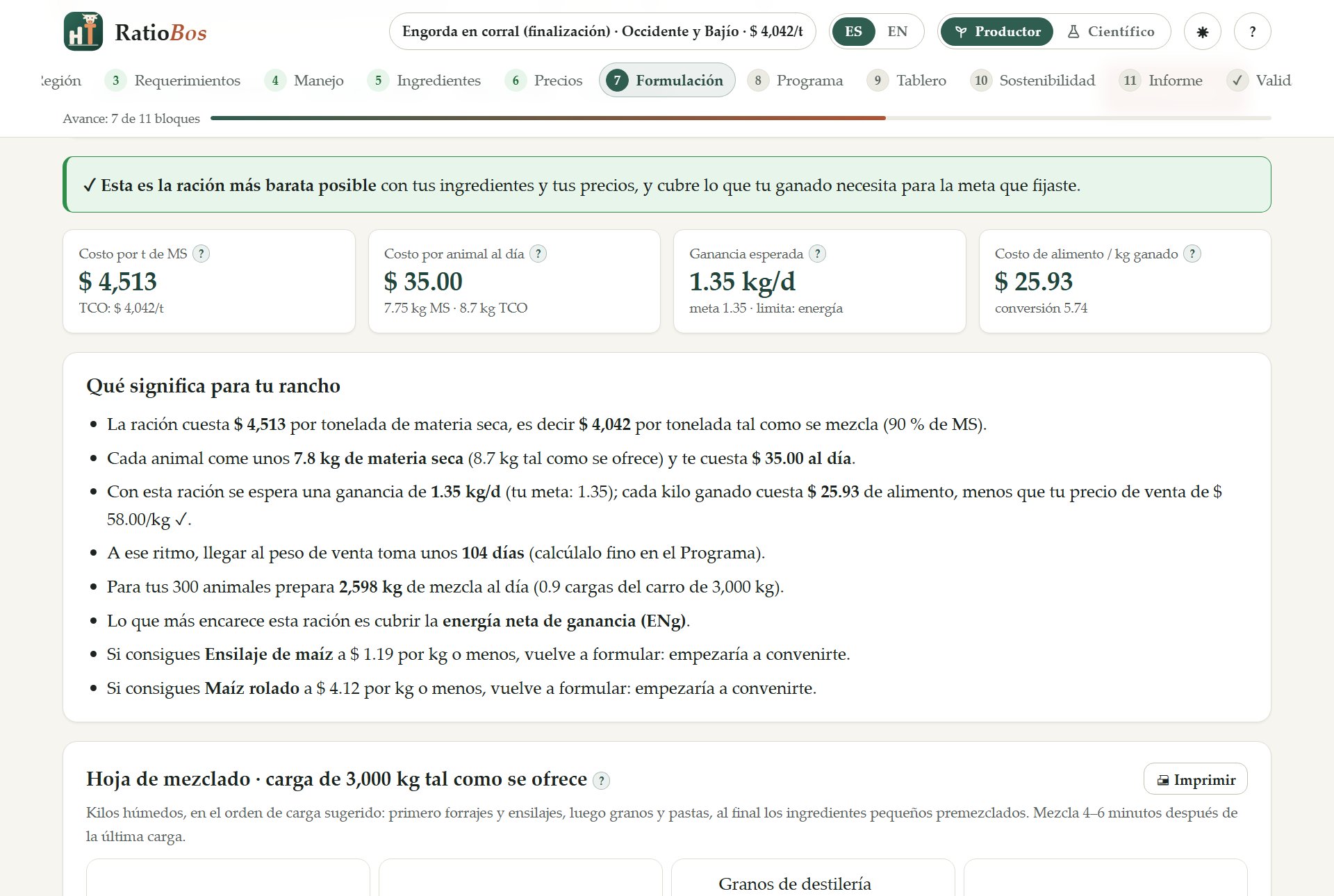
Las cuatro tarjetas del resultadoThe four result cards
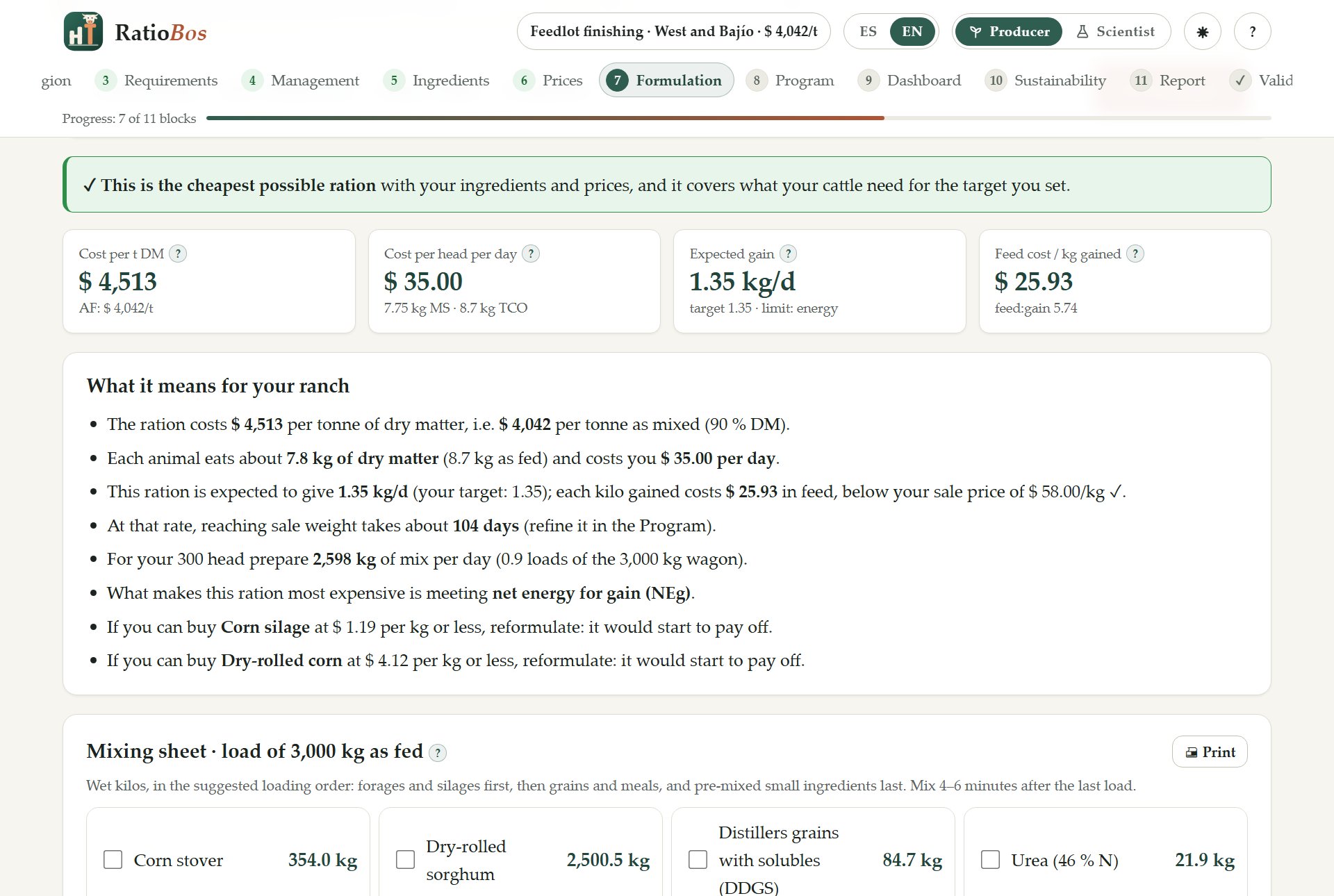
- Confirmación de mínimo costo.Least-cost confirmation.
- Las cuatro tarjetas que se explican abajo.The four cards explained below.
| Tarjeta | Card | Qué te dice | What it tells you |
|---|---|---|---|
| Costo por t de MS | Cost per t DM | Lo que cuesta una tonelada de la ración sin agua. Abajo, la misma tonelada húmeda, como sale del carro. | What a tonne of the ration costs without water. Below, the same tonne wet, as it leaves the wagon. |
| Costo por animal al día | Cost per head per day | Consumo esperado × precio. El gasto diario de alimento de cada cabeza. | Expected intake × price. Each head’s daily feed bill. |
| Ganancia esperada | Expected gain | La que permite la ración, y qué la limita: energía o proteína. | The gain the ration allows, and what limits it: energy or protein. |
| Costo de alimento por kg ganado | Feed cost per kg gained | El número del negocio. Debe quedar bien por debajo de tu precio de venta. | The business number. It must sit well below your sale price. |
Qué significa para tu ranchoWhat it means for your ranch
Debajo de las tarjetas, la app traduce los números a frases: cuánto come cada animal, cuántos días faltan para el peso de venta, cuántos kilos mezclar al día y qué ingrediente empezaría a convenirte si bajara de precio.
Below the cards, the app turns the numbers into sentences: how much each animal eats, how many days remain to sale weight, how many kilos to mix per day and which ingredient would start to pay off if its price fell.
La ración cuesta $4,042 por tonelada tal como se mezcla. Cada torete come 8.7 kg al día y cuesta $35.00. Se espera que gane 1.35 kg/d, a $25.93 de alimento por kilo ganado: menos de la mitad de los $58 a los que lo venderemos. Para los 300 animales hay que preparar 2,598 kg al día, poco menos de una carga del carro, y llegarán al peso de venta en unos 104 días.
The ration costs $4,042 per tonne as mixed. Each bull eats 8.7 kg a day and costs $35.00. Expected gain is 1.35 kg/d, at $25.93 of feed per kilo gained: less than half the $58 we will sell it for. For the 300 animals we must prepare 2,598 kg a day, just under one wagon load, and they will reach sale weight in about 104 days.
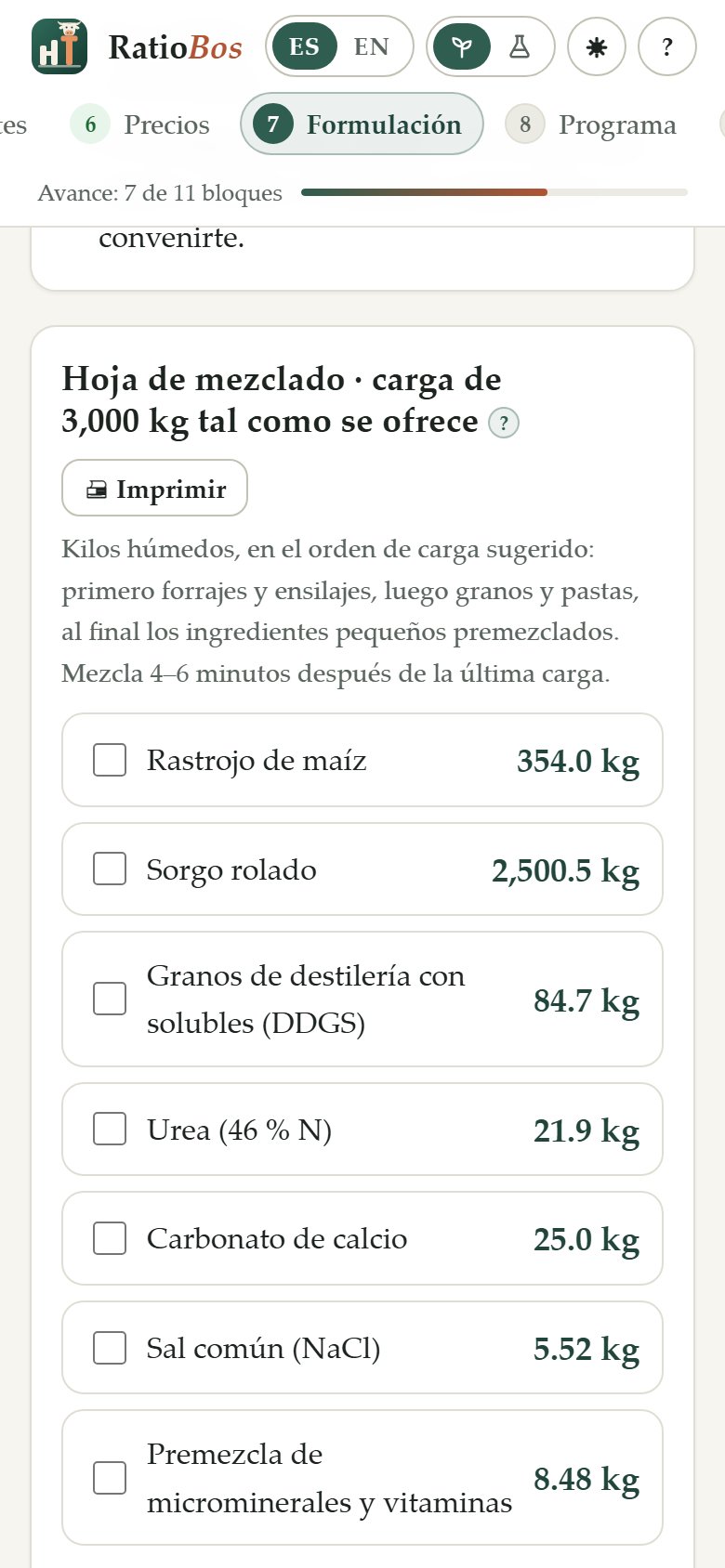
La hoja del carro mezcladorThe mixer-wagon sheet
Es lo que se lleva al corral. Los kilos son húmedos, tal como los pesa la báscula del carro, y vienen en el orden de carga: primero forrajes y ensilajes, luego granos y pastas, al final los ingredientes pequeños premezclados. Cada renglón tiene una casilla para palomear al cargar.
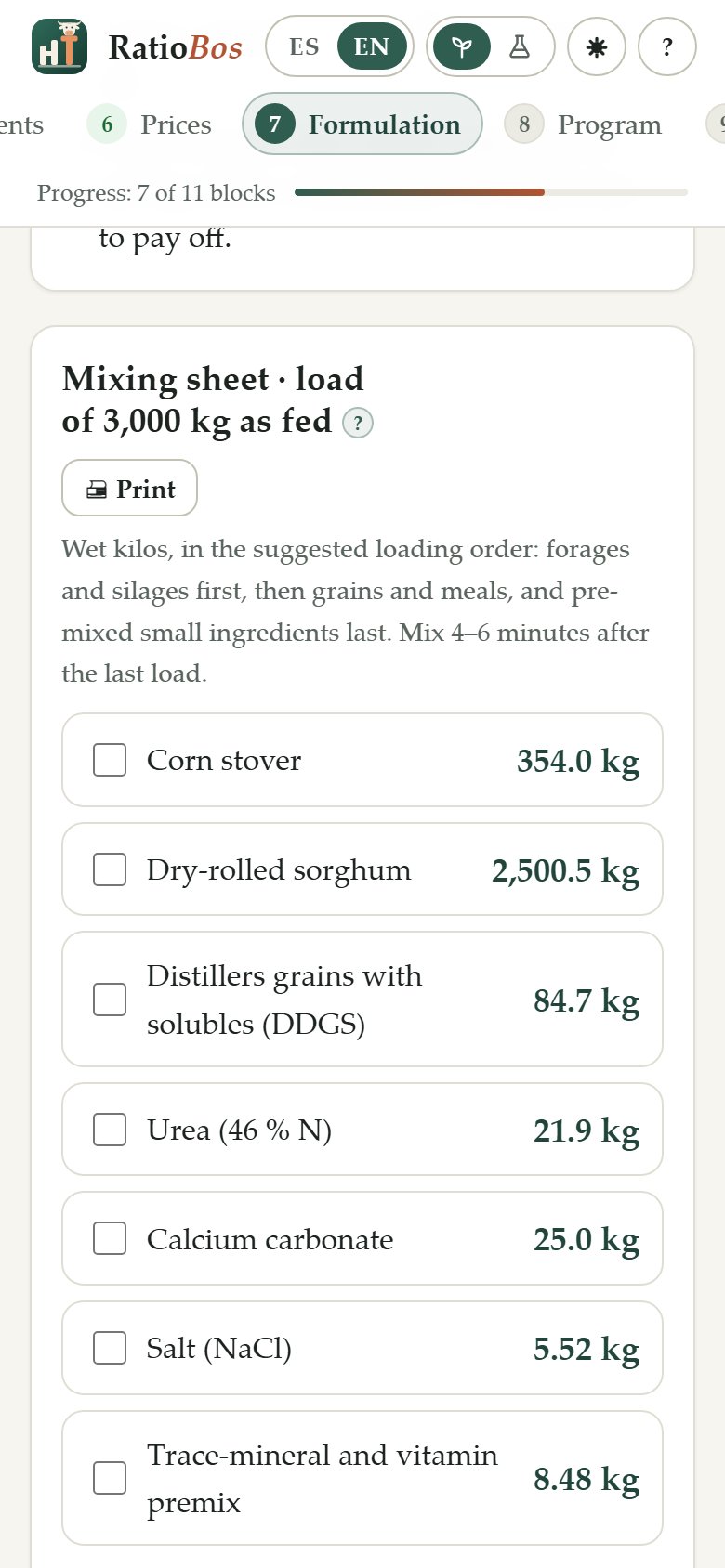
This is what goes to the pen. The kilos are wet, as the wagon scale weighs them, and come in loading order: forages and silages first, then grains and meals, and the small pre-blended ingredients last. Each line has a box to tick as you load.
- 🖨 Imprimir saca solo la hoja, en una página.🖨 Print prints just the sheet, on one page.
| Orden | Order | Ingrediente | Ingredient | kg |
|---|---|---|---|---|
| 1 | Rastrojo de maíz | Corn stover | 354.0 | |
| 2 | Sorgo rolado | Dry-rolled sorghum | 2,500.5 | |
| 3 | Granos de destilería (DDGS) | Distillers grains (DDGS) | 84.7 | |
| 4 | Urea · carbonato · sal · premezcla (premezclados) | Urea · limestone · salt · premix (pre-blended) | 21.9 · 25.0 · 5.52 · 8.48 | |
| Total de la carga · $12,125.09 · alcanza para 346 animales-día | Load total · $12,125.09 · feeds 346 head-days | 3,000 |
Juntos son 61 kg en una carga de 3,000. Si se echan directo al carro, se reparten mal y unos animales comen de más. Revuélvelos antes con unos 50 kg de sorgo molido y agrega esa premezcla al final. La urea mal mezclada puede intoxicar.
Together they are 61 kg in a 3,000 kg load. Tipped straight into the wagon they spread badly and some animals get too much. Blend them first with about 50 kg of ground sorghum and add that premix last. Poorly mixed urea can poison cattle.
La fórmula y el semáforo ruminalThe formula and the rumen traffic light
La fórmula se ve en una dona y en una tabla, en materia seca o tal como se ofrece (botón arriba a la derecha). La tabla dice también cuántos kilos come cada animal de cada ingrediente y cuánto aporta cada uno al costo.
The formula appears as a doughnut and a table, on a dry-matter or as-fed basis (button at the top right). The table also shows how many kilos of each ingredient each animal eats and how much each adds to the cost.
Más abajo, dos barras comparan la energía y la proteína del día contra lo que el animal necesita, y el semáforo de salud ruminal revisa lo que el costo mínimo podría descuidar.
Further down, two bars compare the day’s energy and protein against what the animal needs, and the rumen-health traffic light checks what least cost might neglect.
| Fibra efectiva (FDNfe) | Effective fibre (peNDF) | Abajo de 7 % en finalización: riesgo de acidosis y timpanismo. Sube el rastrojo. | Below 7 % in finishing: risk of acidosis and bloat. Add stover. |
| Grasa total | Total fat | Arriba de 6–7 % frena la digestión de la fibra. | Above 6–7 % slows fibre digestion. |
| Urea | Urea | Amarillo arriba de 1 % de la MS o de 25 % de la proteína; rojo arriba de 1.2 % o de 35 %: riesgo de intoxicación. | Amber above 1 % of DM or 25 % of the protein; red above 1.2 % or 35 %: toxicity risk. |
| Azufre | Sulfur | Amarillo arriba de 0.30 %, rojo arriba de 0.40 %: polioencefalomalacia. El semáforo no cuenta el agua; si tu agua es sulfatada, quédate lejos del límite. | Amber above 0.30 %, red above 0.40 %: polioencephalomalacia. The light does not count water; if your water is high in sulfate, stay well below the limit. |
| Ca : P | Ca : P | Verde desde 1.5 : 1; amarillo entre 1.2 y 1.5; rojo abajo de 1.2. Un Ca : P bajo eleva el riesgo de cálculos urinarios en machos: sube un poco el carbonato. | Green from 1.5 : 1; amber between 1.2 and 1.5; red below 1.2. A low Ca : P raises the risk of urinary stones in males: add a little limestone. |
Todo en verde salvo el Ca : P, en amarillo (1.49 : 1, apenas abajo de 1.5). En toretes conviene corregirlo: si en el Bloque 6 subimos el mínimo de carbonato a 1.1 % y volvemos a formular, el Ca : P pasa a 1.69 : 1 y la tonelada de MS cuesta solo $2 más ($4,515). Para no mover los números del ejemplo, en los capítulos siguientes seguimos con la fórmula original.
All green except Ca : P, in amber (1.49 : 1, just under 1.5). In bulls it is worth fixing: if in Block 6 we raise the limestone minimum to 1.1 % and formulate again, Ca : P rises to 1.69 : 1 and a tonne of DM costs only $2 more ($4,515). To keep the example’s numbers, the following chapters stay with the original formula.
¿Qué ingredientes conviene vigilar?Which ingredients are worth watching?
La tabla Ingredientes no usados · precio de entrada dice a qué precio empezaría a convenirte un ingrediente que quedó fuera. Úsala para negociar con tu proveedor.
The Unused ingredients · entry price table tells you at what price an ingredient left out would start to pay off. Use it when negotiating with your supplier.
Si aparece «Sin solución»If “No solution” appears
Significa que ninguna mezcla de tus ingredientes cumple todo a la vez. En animales en crecimiento, lo más común es que la meta de ganancia sea más alta de lo que permiten los ingredientes o el clima. La app calcula la ganancia máxima posible y ofrece un botón para usarla.
It means no blend of your ingredients meets everything at once. In growing animals, the usual cause is a gain target higher than the ingredients or the climate allow. The app works out the maximum feasible gain and offers a button to use it.
- Usar 1.30 kg/d y formular.Use 1.30 kg/d and formulate.
- ¿La app ofrece una ganancia máxima?Does the app offer a maximum gain?Úsala, o agrega un ingrediente de más energía (maíz hojueleado, grasa) para alcanzar tu meta.Use it, or add a higher-energy ingredient (steam-flaked corn, fat) to reach your target.
- ¿Editaste la tabla del Bloque 3?Did you edit the Block 3 table?Presiona ↺ Recalcular con el animal y formula otra vez.Press ↺ Recompute from the animal and formulate again.
- ¿Dice «Ningún ingrediente aporta…»?Does it say “No selected ingredient supplies…”?Marca en el Bloque 5 uno que lo aporte: carbonato para el calcio, sal para el sodio, una pasta para la proteína.Tick one in Block 5 that supplies it: limestone for calcium, salt for sodium, a meal for protein.
- ¿Sigue sin solución?Still no solution?La app lista las restricciones que, relajando una sola, darían solución. Revisa esos límites en el Bloque 6.The app lists the constraints where relaxing just one would give a solution. Check those limits in Block 6.
Programa de alimentación
Feeding program
Toda la estancia en el corral, día a día: cuántos días tarda, cuánto alimento y dinero se va y cuánto te queda por cabeza.
The whole stay in the pen, day by day: how many days it takes, how much feed and money it uses and what is left per head.
Las fasesThe phases
En engorda, la app propone tres fases: recepción y adaptación (mucho forraje para que el rumen se acostumbre al grano), crecimiento y finalización. Para cada una puedes cambiar el peso al que termina, la meta de ganancia y el rango de forraje. Escribe el peso de venta y presiona ⚙ Formular el programa.
For a feedlot the app proposes three phases: receiving and step-up (plenty of forage so the rumen adapts to grain), growing and finishing. For each you can change its end weight, gain target and forage range. Enter the sale weight and press ⚙ Formulate the program.
Porque la recepción, con 34 % de forraje, gana menos (1.08 kg/d) y porque en cada fase la app hace crecer al animal con la ganancia que de verdad permite la ración, día a día. El promedio de los 110 días es 1.27 kg/d. Por la misma razón el costo por kilo del programa ($31.40) es mayor que el de la ración del Bloque 7 ($25.93), calculada para el torete de 380 kg: la finalización es más cara y el animal pesado convierte peor.
Because receiving, with 34 % forage, gains less (1.08 kg/d) and because in every phase the app grows the animal at the gain the ration really allows, day by day. The 110-day average is 1.27 kg/d. For the same reason the program’s cost per kilo ($31.40) is higher than that of the Block 7 ration ($25.93), computed for the 380 kg bull: finishing is dearer and the heavier animal converts worse.
La curva de crecimientoThe growth curve
La economía del loteBatch economics
- ⬇ Descargar programa (CSV) para abrirlo en Excel.⬇ Download program (CSV) to open it in Excel.
El programa tarda 110 días de 380 a 520 kg. Cada torete come 950 kg de materia seca, que cuestan $4,399. La utilidad es de $1,216 por cabeza y $364,943 para el lote. El precio de equilibrio es $55.66: si el kilo en pie baja de ahí, el lote pierde dinero. Con un margen de apenas $2.34 por kilo sobre el equilibrio, conviene cerrar la venta antes de comprar.
The program takes 110 days from 380 to 520 kg. Each bull eats 950 kg of dry matter, costing $4,399. Profit is $1,216 per head and $364,943 for the lot. The break-even price is $55.66: if live weight sells below that, the lot loses money. With a margin of only $2.34 per kilo over break-even, it pays to agree the sale before buying.
Tablero de resultados
Results dashboard
Todos los números que importan en una sola vista y en gráficas: lo que logra la ración, la ganancia que deja más dinero, el costo en cada región y el riesgo del precio del grano.
Every number that matters in one view and in charts: what the ration achieves, the most profitable gain, the cost in each region and the grain-price risk.
Parámetros logradosAchieved performance
La tabla pone lado a lado la ración actual y el programa completo con los cuatro indicadores clásicos de una engorda.
The table sets the current ration beside the whole program with the four classic feedlot indicators.
| Indicador | Indicator | Cómo se calcula | How it is computed | Ración | Ration | Programa | Program |
|---|---|---|---|---|---|---|---|
| Ganancia diaria (GDP) | Average daily gain (ADG) | kg ganados ÷ días | kg gained ÷ days | 1.35 | 1.27 | ||
| Eficiencia alimenticia | Feed efficiency | ganancia ÷ alimento (más alto, mejor) | gain ÷ feed (higher is better) | 0.174 | 0.147 | ||
| Conversión alimenticia | Feed conversion | alimento ÷ ganancia (más bajo, mejor) | feed ÷ gain (lower is better) | 5.74 | 6.78 | ||
| Beneficio : costo | Benefit : cost | lo que entra ÷ lo que sale (mayor que 1 = gana) | money in ÷ money out (over 1 = profit) | 1.78 | 1.04 |
La de la ración compara el valor de lo que el animal gana en un día con lo que cuesta alimentarlo ese día: 1.78 dice que cada peso de alimento y manejo produce $1.78 de carne. La del programa incluye además la compra del animal, que es la mayor inversión: 1.04 es la rentabilidad real del negocio completo. La app muestra también el valor agregado (venta menos compra, entre alimento y otros costos): 1.23.
The ration ratio compares the value of what the animal gains in a day with what feeding it costs that day: 1.78 says each peso of feed and management produces $1.78 of beef. The program ratio also includes buying the animal, the biggest investment: 1.04 is the real return on the whole business. The app also shows the value added (sale minus purchase, over feed and other costs): 1.23.
¿Qué ganancia deja más dinero?Which gain pays best?
Ganar más rápido no siempre conviene: cada kilo extra exige una ración más cara. La app formula la ración para varias metas de ganancia y dibuja dos curvas: el margen por animal al día (verde) y el costo de alimento por kilo ganado (terracota). El círculo marca el óptimo económico.
Faster gain does not always pay: each extra kilo demands a dearer ration. The app formulates for several gain targets and plots two curves: the margin per head per day (green) and the feed cost per kilo gained (terracotta). The circle marks the economic optimum.
Con nuestros precios, la mayor utilidad diaria se logra con 1.40 kg/d: $36.44 por animal al día contra $34.30 de nuestra meta de 1.35. La diferencia es pequeña: la meta ya está cerca del óptimo y la app lo dice con una palomita.
At our prices, the highest daily profit comes at 1.40 kg/d: $36.44 per head per day against $34.30 at our 1.35 target. The gap is small: the target is already close to the optimum and the app says so with a tick.
El mismo animal en cada regiónThe same animal in every region
La app repite tu formulación en las 9 regiones, con el clima de la temporada, tu sombra y los precios estimados de cada una. Si el clima de una región no permite tu meta, usa la ganancia máxima posible allí y la marca con un asterisco.
The app repeats your formulation in all 9 regions, with the season’s climate, your shade and each region’s estimated prices. If a region’s climate does not allow your target, it uses the maximum feasible gain there and marks it with an asterisk.
Si cambia el precio del granoIf the grain price changes
La gráfica mueve el precio del ingrediente que más pesa en el costo (en el caso, el sorgo) de 70 % a 130 % del actual y reformula en cada punto. La línea verde es el costo por tonelada; la terracota, cuánto sorgo queda en la ración.
The chart moves the price of the ingredient that weighs most in the cost (sorghum, in our case) from 70 % to 130 % of today’s and reformulates at each point. The green line is the cost per tonne; the terracotta one, how much sorghum stays in the ration.
Mientras la línea terracota sea plana, el sorgo es insustituible y su precio pega de lleno en tu costo: es el ingrediente para comprar por adelantado o con contrato. Cuando la línea cae, la app ya encontró con qué reemplazarlo. En el caso, desde 10 % de aumento empieza a sustituirlo con ensilaje, melaza y DDGS, y a partir de 25 % lo cambia por completo por maíz rolado.
While the terracotta line is flat, sorghum is irreplaceable and its price hits your cost in full: that is the ingredient to buy ahead or under contract. When the line drops, the app has found a substitute. In our case, from a 10 % rise it starts replacing it with silage, molasses and DDGS, and from 25 % it switches entirely to dry-rolled corn.
Compárate con engordas publicadasCompare yourself with published feedlots
Al final del tablero hay una tabla con la ganancia, el consumo, la eficiencia, la conversión y el beneficio : costo de engordas experimentales publicadas en México y en el sur de Estados Unidos, del CIPES de Sonora a Sinaloa, Zacatecas y El Centro, California. Sirve para saber si tus números son razonables.
At the end of the dashboard is a table with gain, intake, efficiency, conversion and benefit : cost from experimental feedlots published in Mexico and the southern United States, from CIPES in Sonora to Sinaloa, Zacatecas and El Centro, California. Use it to check that your numbers are reasonable.
Huella ambiental y producción sostenible
Environmental footprint and sustainable production
Producir carne usa agua y suelo y deja gases, nutrientes y residuos. Aquí ves cuánto, y buscas el equilibrio entre utilidad y ambiente.
Producing beef uses water and land and leaves gases, nutrients and waste. Here you see how much, and look for the balance between profit and the environment.
RatioBos usa la palabra sostenibilidad como la define la FAO: producir hoy sin comprometer la capacidad de producir mañana, en sus tres dimensiones a la vez: ambiental, económica y social. Por eso este bloque no busca la ración «más verde» a cualquier precio, sino la que reduce la huella sin dejar de ser rentable.
RatioBos uses the word sustainability as FAO defines it: producing today without compromising the capacity to produce tomorrow, in its three dimensions at once: environmental, economic and social. That is why this block does not seek the “greenest” ration at any price, but the one that cuts the footprint and still pays.
El semáforo de sostenibilidadThe sustainability traffic light
| Luz | Light | Qué mide | What it measures | En el caso | In our case |
|---|---|---|---|---|---|
| Gases de efecto invernadero | Greenhouse gases | Metano del rumen y del estiércol, óxido nitroso y la producción del alimento, en CO₂ equivalente por kg ganado. | Methane from the rumen and manure, nitrous oxide and feed production, in CO₂ equivalent per kg gained. | 5.1 kg | |
| Agua | Water | Agua de lluvia y de riego que costó producir el alimento, por kg ganado. | Rain and irrigation water it took to grow the feed, per kg gained. | 16.8 m³ | |
| Amoniaco al aire | Ammonia to air | Nitrógeno que se evapora del estiércol: olor, polvo fino y lluvia ácida. | Nitrogen volatilised from manure: odour, fine dust and acid rain. | 47 g/d | |
| Nitratos al agua | Nitrates to water | Nitrógeno que puede lavarse hacia pozos y ríos en clima húmedo. | Nitrogen that can leach to wells and rivers in a wet climate. | 31 g/d | |
| Medicamentos | Medicines | Si usas antibióticos de importancia médica en humanos (clasificación de la OMS). | Whether you use antibiotics important in human medicine (WHO list). | ninguno | none |
Gases y recursosGases and resources
Las barras de gases separan de dónde viene cada kilo de CO₂ equivalente. En el caso, la producción del alimento (3.08 kg al día) pesa más que el metano del rumen (2.35 kg): en una ración alta en grano el rumen produce poco metano, pero el grano trae su propia huella del campo. Junto, cuatro tarjetas dan el agua de bebida, la huella hídrica del alimento, la tierra para producirlo y la superficie para aplicar el estiércol.
The gas bars split where each kilo of CO₂ equivalent comes from. In our case feed production (3.08 kg a day) outweighs rumen methane (2.35 kg): on a high-grain ration the rumen makes little methane, but the grain carries its own footprint from the field. Beside it, four cards give drinking water, the feed’s water footprint, the land to grow it and the area to spread the manure.
Nuestros 300 toretes, en 110 días, producen unas 397 toneladas de heces frescas con 4.3 t de nitrógeno y 0.6 t de fósforo. Para aplicarlas sin contaminar se necesitan 24.9 hectáreas de cultivo (límite de 170 kg de N o 25 kg de P por hectárea al año). Si no las tienes, hay que compostear el estiércol o venderlo a quien sí.
Our 300 bulls, over 110 days, produce about 397 tonnes of fresh faeces with 4.3 t of nitrogen and 0.6 t of phosphorus. To spread it without polluting takes 24.9 hectares of cropland (limit of 170 kg N or 25 kg P per hectare a year). If you do not have them, compost the manure or sell it to someone who does.
Medicamentos por categoríaMedicines by category
Con lo que capturaste en el Bloque 4, la app calcula cuánto de cada producto recibe cada animal y todo el lote, y lo clasifica: ionóforos (sin importancia en medicina humana), implantes hormonales, antiparasitarios, vacunas y, si los usas, antibióticos según la lista de la OMS y β-agonistas.
From what you entered in Block 4, the app works out how much of each product each animal and the whole lot receive, and classifies it: ionophores (no importance in human medicine), hormonal implants, antiparasitics, vaccines and, if used, antibiotics by WHO category and β-agonists.
Optimizar costo y ambiente a la vezOptimising cost and environment together
El botón ⚙ Calcular la frontera costo–huella formula varias veces sumando al precio de cada ingrediente un precio interno del carbono por sus emisiones, de $0 a $20,000 por tonelada de CO₂e. Resultado: una curva con las mejores raciones posibles; ninguna otra es a la vez más barata y más limpia. El punto de equilibrio es el que más huella quita por cada peso extra.
The ⚙ Compute the cost–footprint frontier button formulates several times, adding to each ingredient’s price an internal carbon price for its emissions, from $0 to $20,000 per tonne of CO₂e. The result is a curve of the best possible rations; no other is both cheaper and cleaner. The balance point is the one that removes the most footprint per extra peso.
- Usar la ración de equilibrio la manda al Bloque 7 como tu ración.Use the balance ration sends it to Block 7 as your ration.
Con un precio interno de $5,000 por tonelada, la app cambia parte del sorgo por melaza y DDGS: la huella baja 3.6 % (de 5.15 a 4.96 kg de CO₂e por kilo ganado) y el kilo ganado cuesta 2.5 % más ($26.58). Cada tonelada de CO₂e evitada cuesta unos $3,500, del orden del costo social del carbono. Es una decisión de negocio: conviene si tu comprador paga una prima por carne de menor huella.
With an internal price of $5,000 per tonne, the app swaps part of the sorghum for molasses and DDGS: the footprint falls 3.6 % (from 5.15 to 4.96 kg CO₂e per kilo gained) and each kilo gained costs 2.5 % more ($26.58). Each tonne of CO₂e avoided costs about $3,500, in the range of the social cost of carbon. It is a business decision: worth it if your buyer pays a premium for lower-footprint beef.
Informe y exportación
Report and export
Un reporte para tu asesor, tablas para Excel y un archivo con todo tu proyecto.
A report for your advisor, tables for Excel and a file with your whole project.
El informeThe report
Un resumen en una frase, la fórmula en materia seca, tal como se ofrece y en kilos por tonelada de mezcla, con el nombre del corral, el rancho y la fecha. 🖨 Imprimir / PDF lo saca en papel o lo guarda en PDF para mandarlo por WhatsApp o correo.
A one-sentence summary and the formula on a dry-matter basis, as fed and in kilos per tonne of mix, with the pen, ranch and date. 🖨 Print / PDF prints it or saves it as a PDF to send by WhatsApp or e-mail.
Exportar y guardarExport and save
| Botón | Button | Qué hace | What it does |
|---|---|---|---|
| ⬇ Fórmula (CSV)⬇ Formula (CSV) | La fórmula con precios y aporte al costo, para Excel. | The formula with prices and cost share, for Excel. | |
| ⬇ Nutrientes (CSV)⬇ Nutrients (CSV) | El aporte de cada nutriente contra su mínimo y máximo. | Each nutrient’s supply against its minimum and maximum. | |
| 💾 Guardar proyecto (.json)💾 Save project (.json) | Todo: animal, región, ingredientes, precios, resultado y programa. Ábrelo en otra computadora con 📂 Abrir proyecto. | Everything: animal, region, ingredients, prices, result and program. Open it on another computer with 📂 Open project. | |
| Reiniciar todoReset everything | Vuelve a los valores de fábrica. Guarda antes tu proyecto. | Back to factory values. Save your project first. |
Nombra el proyecto con el corral y la fecha (por ejemplo, «Corral 4 · 2026-10-06»). Al terminar la engorda podrás comparar lo que la app predijo con lo que pesaron tus animales: es la mejor forma de afinar los datos de tu rancho.
Name the project with the pen and date (for example, “Pen 4 · 2026-10-06”). When the feeding period ends you can compare what the app predicted with what your animals weighed: the best way to fine-tune your ranch’s data.
Del papel al comedero
From paper to feed bunk
La mejor ración no sirve si se mezcla mal o se cambia de golpe. Cinco minutos de revisión evitan una carga equivocada y un brote de acidosis.
The best ration is worthless if it is mixed badly or changed overnight. Five minutes of checking prevent a wrong load and an acidosis outbreak.
Antes de cargar el carroBefore loading the wagon
- Los precios del Bloque 6 son de esta semana, puestos en el rancho.
- The prices in Block 6 are this week’s, delivered to the ranch.
- La materia seca del ensilaje está al día: cambia con cada silo y con la lluvia. Una prueba con microondas o con un horno basta.
- The silage dry matter is up to date: it changes with every silo and with rain. A microwave or oven test is enough.
- El peso y la meta del Bloque 3 son los del lote que va a comer esta ración.
- The weight and target in Block 3 are those of the lot that will eat this ration.
- Todos los ingredientes de la fórmula están en bodega, en la cantidad necesaria.
- Every ingredient in the formula is in stock, in the amount needed.
- La carga del carro del Bloque 4 es la de tu mezclador y la báscula está calibrada.
- The wagon load in Block 4 matches your mixer, and the scale is calibrated.
- Urea, sal, minerales y premezcla están premezclados con un poco de grano molido.
- Urea, salt, minerals and premix are pre-blended with a little ground grain.
- Tu médico veterinario zootecnista o nutriólogo revisó el informe. RatioBos es una herramienta de apoyo, no un sustituto.
- Your veterinarian or nutritionist has reviewed the report. RatioBos is a support tool, not a substitute.
Cambia de ración poco a pocoChange rations gradually
El rumen necesita tiempo para cambiar sus microbios del forraje al grano. Por eso el programa empieza con una ración de recepción con 30–45 % de forraje. Entre una ración y la siguiente, haz el cambio en 3 a 5 días, mezclando ambas o subiendo el grano de a poco, y no subas el grano más de 10 puntos de una vez.
The rumen needs time to shift its microbes from forage to grain. That is why the program starts with a receiving ration of 30–45 % forage. Between one ration and the next, switch over 3 to 5 days, blending both or raising grain step by step, and never raise grain by more than 10 points at once.
Heces líquidas y con burbujas, animales que dejan de comer, cojeras unos días después y consumo que sube y baja. Si las ves, regresa a la ración anterior y consulta a tu veterinario.
Loose, bubbly faeces, animals going off feed, lameness a few days later and intake that swings up and down. If you see them, go back to the previous ration and call your veterinarian.
Lee el comedero cada mañanaRead the bunk every morning
El consumo real manda. Antes de la primera repartición, mira cuánto alimento sobró y ajusta la cantidad del día:
Actual intake rules. Before the first feeding, look at what is left and adjust the day’s amount:
| Lamido, sin nadaLicked clean | Sube 5 % la cantidad del día. | Raise the day’s amount 5 %. |
| Migajas, una capa delgadaCrumbs, a thin layer | Correcto. No cambies. | Right. No change. |
| Sobra 5–10 %5–10 % left | Baja 5 %. Revisa si hay calor o un animal enfermo. | Cut 5 %. Check for heat or a sick animal. |
| Sobra más de 10 %Over 10 % left | Baja 10 % y revisa la mezcla, el agua y la salud del corral. | Cut 10 % and check the mix, water and pen health. |
Cuando conozcas el consumo real de tu lote durante una o dos semanas, escríbelo en el Bloque 3 (Consumo real de MS). La app lo usará en lugar de su predicción y la ganancia esperada se ajustará a tu corral.
Once you know your lot’s actual intake over a week or two, enter it in Block 3 (Actual DM intake). The app will use it instead of its prediction, and the expected gain will match your pen.
Problemas frecuentes
Troubleshooting
Las preguntas más comunes, con su causa y su solución.
The most common questions, with cause and fix.
Cambié un precio y el resultado desapareció.I changed a price and the result disappeared.
Es a propósito. Cualquier cambio en precios, ingredientes o requerimientos borra la fórmula anterior para que nunca mezcles con un resultado viejo. Vuelve a presionar ⚙ Formular.
That is deliberate. Any change in prices, ingredients or requirements clears the previous formula so you never mix from a stale result. Press ⚙ Formulate again.
Aparece «Sin solución».“No solution” appears.
Sigue el diagrama de la sección 7.7. En animales en crecimiento, casi siempre basta con usar la ganancia máxima que propone la app.
Follow the chart in section 7.7. For growing animals, using the maximum gain the app proposes is almost always enough.
La ganancia esperada es mayor que mi meta.The expected gain is higher than my target.
Pasa con metas bajas en engorda: el forraje está limitado a 8–15 %, así que la ración no puede diluirse más y el animal gana más de lo que pediste. Es buena noticia. Si quieres una ganancia moderada, usa el tipo Becerros en desarrollo, que admite más forraje.
It happens with low feedlot targets: forage is capped at 8–15 %, so the ration cannot be diluted further and the animal gains more than you asked. That is good news. For moderate gain, use the Growing calves type, which allows more forage.
La ración no lleva el ingrediente que más uso.The ration leaves out my main ingredient.
A ese precio no conviene. Mira su precio de entrada en la sección 7.6. Si de todos modos quieres usarlo (por ejemplo, porque ya lo compraste), fija un mínimo en el Bloque 6.
At that price it does not pay. Check its entry price in section 7.6. If you want to use it anyway (because you have already bought it, say), set a minimum in Block 6.
Los kilos del carro no suman lo que esperaba.The wagon kilos are not what I expected.
Revisa la materia seca de los ensilajes y forrajes verdes: un ensilaje capturado con 34 % de MS pesa casi el triple tal como se ofrece. Si tu silo tiene 28 %, cámbialo en el Bloque 5.
Check the dry matter of silages and fresh forages: a silage entered at 34 % DM weighs almost three times more as fed. If your silo is at 28 %, change it in Block 5.
Abrí la app en otra computadora y no están mis datos.I opened the app on another computer and my data is missing.
Los datos se guardan en el navegador de cada computadora. Lleva tu proyecto con Informe›Guardar proyectoReport›Save project y ábrelo allá con 📂 Abrir proyecto.
Data is kept in each computer’s browser. Carry your project with the save button and open it there with 📂 Open project.
El ITH dice «emergencia» y mi ganado está bien.The THI says “emergency” but my cattle are fine.
La app usa el clima promedio de la región y temporada. Si tu rancho es más fresco (altura, viento, más sombra), corrige la temperatura y la humedad en Ambiente que usa el modelo, al final del Bloque 2.
The app uses the regional average for the season. If your ranch is cooler (altitude, wind, more shade), correct temperature and humidity under Environment used by the model, at the end of Block 2.
¿Puedo formular para vacas en agostadero?Can I formulate for cows on rangeland?
Sí. Elige Vacas gestantes o Vacas en lactación, el sistema Pastoreo (plano o lomerío) en el Bloque 2 y captura el forraje del potrero como ingrediente, con su análisis. La app calculará qué suplemento le falta al pasto.
Yes. Choose Pregnant cows or Lactating cows, the Grazing system (flat or hilly) in Block 2, and enter the pasture forage as an ingredient, with its analysis. The app will work out what supplement the grass lacks.
Glosario
Glossary
Las palabras técnicas de este instructivo, en lenguaje llano.
The technical words in this guide, in plain language.
RatioBos en una página
RatioBos on one page
Escanea para abrir la appScan to open the app

- 1AnimalAnimalTipo de animal, biotipo (cruza, cebú…) y sexo.Animal type, biotype (cross, zebu…) and sex.
- 2RegiónRegionToca tu estado y la temporada. Revisa el ITH, la sombra y el piso.Tap your state and season. Check THI, shade and floor.
- 3RequerimientosRequirementsPeso del lote y ganancia diaria objetivo.Lot weight and daily gain target.
- 4ManejoManagementImplante, ionóforo, cabezas, carga del carro, compra y venta.Implant, ionophore, head count, wagon load, buy and sell.
- 5IngredientesIngredientsMarca lo que hay. Corrige la MS del ensilaje.Tick what you have. Fix the silage DM.
- 6PreciosPricesPrecio de esta semana, puesto en el rancho. Revisa los máximos.This week’s delivered price. Check the maximums.
- 7FormulaciónFormulation⚙ Formular. Revisa el semáforo e imprime la hoja del carro.⚙ Formulate. Check the traffic light and print the wagon sheet.
- 8ProgramaProgram⚙ Formular el programa: días en corral y utilidad por cabeza.⚙ Formulate the program: days on feed and profit per head.
- 9TableroDashboardGDP, eficiencia, conversión, B : C y la ganancia óptima.ADG, efficiency, conversion, B : C and the optimal gain.
- 10SostenibilidadSustainabilityHuella de la ración y frontera costo–huella.Ration footprint and cost–footprint frontier.
- 11InformeReportPDF para tu asesor y Guardar proyecto (.json).PDF for your advisor and Save project (.json).
Si sale «Sin solución»
If “No solution”
- Usa la ganancia máxima que propone.
- Use the maximum gain it proposes.
- Recalcula la tabla del Bloque 3.
- Recompute the Block 3 table.
- Marca el ingrediente que falta.
- Tick the missing ingredient.
Antes de mezclar
Before mixing
- Precios y MS del ensilaje al día.
- Prices and silage DM up to date.
- Urea y minerales premezclados.
- Urea and minerals pre-blended.
- Cambio de ración en 3–5 días.
- Ration change over 3–5 days.
RatioBos · Instructivo del Productor, 1.ª edición, octubre de 2026. Describe RatioBos 1.0.0. Todas las capturas son de la app real, con los datos del caso descrito en la sección 0.5; los precios son ilustrativos.
RatioBos · Producer Guide, 1st edition, October 2026. Covers RatioBos 1.0.0. Every screenshot comes from the real app with the case data in section 0.5; prices are illustrative.
Herramienta de apoyo: los resultados deben ser revisados por un profesional en nutrición animal. © 2026 Héctor Tecumshé Mojica-Zárate. El programa se distribuye con licencia MIT.
Decision-support tool: results should be reviewed by a qualified animal nutritionist. © 2026 Héctor Tecumshé Mojica-Zárate. The software is distributed under the MIT License.