
Tu parcela como un sistema vivo, tejida hilo por hilo
Your farm as a living system, woven thread by thread
Una guía práctica para describir, evaluar y proyectar tu milpa, parcela o unidad de producción con Ratio Telar: quién la sostiene, qué la regenera, qué la pone en riesgo y hacia dónde va. Con el caso real del maíz criollo de Calpan, Puebla, de principio a fin.
A practical guide to describing, assessing and projecting your milpa, plot or farm with Ratio Telar: who holds it together, what regenerates it, what puts it at risk and where it is heading. With the real case of Calpan landrace maize, Puebla, from start to finish.
Hay otra guía para investigación y docencia: el Instructivo del Científico.There is a companion guide for research and teaching: the Scientist Guide.
Cómo usar este instructivo
How to use this guide
Para quién es, cómo está organizado y qué significa cada señal que encontrarás en las páginas.
Who it is for, how it is organised and what each sign on the page means.
Este instructivo es para quien conoce una parcela, una milpa, un viñedo, un apiario o una granja de traspatio y quiere verla completa: el productor y la productora, el técnico o la técnica de campo, el extensionista, el estudiante que hace su servicio social o su tesis en una comunidad. No necesitas saber programación ni estadística; necesitas conocer tu unidad de producción y a la gente que la trabaja.
This guide is for whoever knows a plot, a milpa, a vineyard, an apiary or a backyard farm and wants to see it whole: farmers, field technicians, extension agents, students doing their social service or thesis in a community. You need no coding or statistics; you need to know your farm and the people who work it.
Sigue el mismo orden que la app: un capítulo por cada bloque de la barra superior, del 1 al 13, cada uno con su color. Todos los ejemplos usan un solo caso, el maíz criollo de San Andrés Calpan, Puebla, documentado por Díaz-José y colaboradores (2026) con 100 informantes entre 2022 y 2024. Así, los números de un capítulo son los que entran al siguiente. Si lo lees de corrido, al terminar habrás tejido, evaluado y proyectado un sistema real.
It follows the app’s order: one chapter for each block in the top bar, 1 to 13, each with its own colour. Every example uses a single case, the landrace maize of San Andrés Calpan, Puebla, documented by Díaz-José and colleagues (2026) with 100 informants between 2022 and 2024. So the numbers in one chapter are the ones that feed the next. Read it start to finish and you will have woven, assessed and projected a real system.
ConvencionesConventions
| Así se escribe | Written as | Significa | Means |
|---|---|---|---|
| Tejer el sistemaWeave the system | Un botón o casilla de la app, con su texto tal como aparece en pantalla. | An app button or field, with its text exactly as on screen. | |
| Informe›Guardar proyectoReport›Save project | Una ruta: abre el primer elemento y luego el siguiente. | A path: open the first item, then the next. | |
| 1.5 | Un valor que escribes tal cual. | A value you type as shown. | |
| 1 | Una marca sobre la captura; su explicación está debajo con el mismo número. | A marker on a screenshot; it is explained below with the same number. | |
| ● Dato publicado · ◆ Lectura de Ratio Telar | Las mismas etiquetas de la app: un dato tomado de una fuente citada, o una propuesta de la app que puedes cambiar. | The app’s own labels: a figure taken from a cited source, or an app proposal you can change. |
Los cinco recuadrosThe five boxes
El caso de ejemplo, paso a paso, con los números reales que da la app.
The worked case, step by step, with the real numbers the app returns.
Atajos y buenas prácticas que ahorran tiempo o evitan errores.
Shortcuts and good practice that save time or avoid mistakes.
Errores frecuentes que pueden llevar a una conclusión equivocada.
Common mistakes that can lead to a wrong conclusion.
La razón detrás de una recomendación, en pocas líneas. Puedes saltarla.
The reason behind a recommendation, in a few lines. You can skip it.
Una tabla corta: si ves esto, haz aquello.
A short table: if you see this, do that.
Cada cifra de la app trae su fuente. Lo que es una propuesta de la app lleva la etiqueta ◆ Lectura de Ratio Telar, y lo que no está documentado aparece como sin dato. Este instructivo sigue la misma regla: los números de Calpan son los que da la app con los datos del artículo; cuando algo es un supuesto, lo decimos.
Every figure in the app carries its source. What the app proposes is labelled ◆ Ratio Telar reading, and what is not documented shows as no data. This guide follows the same rule: the Calpan numbers are those the app returns with the paper’s data; when something is an assumption, we say so.
Abre la app y conoce la pantalla
Open the app and meet the screen
Ratio Telar es una página web que funciona sola en tu navegador. No se instala, no pide cuenta y no manda tus datos a ningún lado.
Ratio Telar is a web page that runs on its own in your browser. Nothing to install, no account, and your data goes nowhere.
Abrir Ratio TelarOpening Ratio Telar
Entra a hectortecumshe-ai.github.io/RatioTelar desde la computadora, la tableta o el celular, o escanea el código QR de la página «Ratio Telar en una página». Se descarga un solo archivo; después funciona sin internet mientras dejes la pestaña abierta, y puedes guardar la página (Ctrl + S) para usarla en la parcela sin señal.
Go to hectortecumshe-ai.github.io/RatioTelar from a computer, tablet or phone, or scan the QR code on the “Ratio Telar on one page” page. It downloads a single file; after that it works offline while the tab stays open, and you can save the page (Ctrl + S) to use it in the field with no signal.
Solo en el navegador que usas. No se suben a internet ni a GitHub. Para pasarlos a otra computadora o compartirlos con tu asesor usa Informe›Guardar proyecto (un archivo .json) y en la otra computadora Informe›Abrir proyecto.
Only in the browser you use. Nothing is uploaded to the internet or to GitHub. To move it to another computer or share it with your adviser use Report›Save project (a .json file) and on the other computer Report›Open project.
La pantalla de inicioThe home screen
- ES / EN cambia el idioma de toda la app, también del informe.ES / EN switches the language of the whole app, report included.
- Productor / Científico cambia la vista; tus datos no se pierden.Producer / Scientist switches the view; your data is kept.
- ☀ / ☾ cambia entre tema de día y de noche.☀ / ☾ switches between day and night themes.
- ? abre la ayuda general. Además, cada dato tiene su propio ?.? opens the general help. Every figure also has its own ?.
- La barra de bloques, del 1 al 13, más Validación y Teoría. Puedes saltar a cualquiera; junto a cada bloque que se llena, una marca dice si está pendiente (○), en proceso (◐) o completo (●).The block bar, 1 to 13, plus Validation and Theory. You can jump to any of them; next to each block you fill in, a mark says whether it is pending (○), in progress (◐) or complete (●).
- La píldora te recuerda qué cultivo y qué localidad estás tejiendo; en un proyecto nuevo dice «Proyecto nuevo · sin datos aún».The pill reminds you which crop and locality you are weaving; in a new project it says “New project · no data yet”.
Las ayudas «?»The “?” helps
Junto a cada número importante hay un ?. Al tocarlo aparece qué significa, cómo se calcula y cómo leerlo, con un semáforo: verde (bien), ámbar (revisa) y rojo (atiende).
Next to every important figure there is a ?. Tap it to see what it means, how it is computed and how to read it, with a traffic light: green (good), amber (check) and red (act).
Vista productor y vista científicaProducer and scientist views
La vista productor muestra lo esencial en lenguaje sencillo; es la que describe este instructivo. La vista científica agrega tablas completas, fórmulas, correlaciones y validación. Puedes cambiar de vista en cualquier momento.
The producer view shows the essentials in plain language; it is the one this guide describes. The scientist view adds full tables, formulas, correlations and validation. You can switch at any time.
La ruta completaThe full route
La app empieza en blanco. Si quieres ver primero un sistema completo, toca Ver el ejemplo publicado (Calpan) en el Inicio: entras al modo ejemplo, recorres los bloques con este instructivo y sales con Salir del ejemplo. Luego llenas el tuyo desde el Bloque 1.
The app starts blank. To first see a complete system, tap See the published example (Calpan) on Home: you enter example mode, walk through the blocks with this guide and leave with Leave the example. Then you fill in yours from Block 1.
Lo tuyo, lo sugerido y el ejemploYours, suggested and the example
Para que nunca confundas un ejemplo con tus propios datos, la app distingue tres cosas a simple vista:
So that you never mistake an example for your own data, the app tells three things apart at a glance:
| Lo que ves | What you see | Qué significa | What it means |
|---|---|---|---|
| Texto gris en cursiva dentro de un campo | Grey italic text inside a field | El campo está vacío; es solo una pista de qué escribir. Nada viene llenado. | The field is empty; it is only a hint of what to write. Nothing comes filled in. |
| Perilla punteada y gris, «Sugerido, sin confirmar» | Dashed grey knob, “Suggested, not confirmed” | La app propone un valor con tus datos. Cuenta como tuyo solo cuando lo mueves o tocas Aceptar sugerencia. | The app proposes a value from your data. It counts as yours only when you move it or tap Accept suggestion. |
| Ventana sepia con la marca de agua «EJEMPLO» | Sepia window with the “EXAMPLE” watermark | Datos publicados de Calpan para consultar. Al cerrarla, tus campos siguen igual. | Published Calpan data for reference. When you close it, your fields stay the same. |
| Franja naranja arriba de la pantalla | Orange band at the top of the screen | Estás en el modo ejemplo. Nada se guarda; Salir del ejemplo te regresa a tu proyecto. | You are in example mode. Nothing is saved; Leave the example takes you back to your project. |
- Marcas por bloque: pendiente, en proceso o completo.Marks per block: pending, in progress or complete.
- Porcentaje total llenado por ti.Total share filled in by you.
Formulación, Tablero, Sostenibilidad, Prospectiva e Informe no muestran resultados vacíos: dicen qué bloques faltan por llenar y te llevan a ellos.
Formulation, Dashboard, Sustainability, Outlook and Report do not show empty results: they say which blocks are still to be filled in and take you there.
Cultivo o especie, variedad y sistema
Crop or species, variety and system
Todo sistema se teje alrededor de algo que se siembra o se cría. Aquí eliges qué es, de qué variedad o raza, y cómo se produce.
Every system is woven around something sown or raised. Here you choose what it is, its variety or breed, and how it is produced.
El catálogoThe catalogue
El catálogo tiene 18 cultivos (uva, maíz criollo, chayote, frijol, calabaza, chile, café, cacao, aguacate, maguey, nopal, jitomate, trigo, caña de azúcar, jamaica, maracuyá, guanábana y mango) y 9 especies animales (bovino, porcino, ovino, caprino, aves de traspatio, abeja melífera, conejo, gallos de pelea y chinicuil), más la granja de traspatio, que combina varias especies. Cada tarjeta dice si tiene Stack documentado (hoy, el maíz de Calpan) o si está Por documentar.
The catalogue has 18 crops (grape, landrace maize, chayote, bean, squash, chili, coffee, cacao, avocado, agave, prickly pear, tomato, wheat, sugarcane, roselle, passion fruit, soursop and mango) and 9 animal species (cattle, pig, sheep, goat, backyard poultry, honeybee, rabbit, gamefowl and chinicuil), plus the backyard farm, which combines several species. Each card shows whether it has a Documented Stack (today, Calpan maize) or is To document.
- La tarjeta elegida lleva palomita.The selected card shows a tick.
- Cultivos / Especies animales cambia de pestaña.Crops / Livestock species switches tabs.
Significa que no existe todavía un Stack publicado para ese cultivo. La app te deja documentarlo tú, y en cada bloque aparece la ventana «Así se hizo con el maíz criollo de Calpan, Puebla» para que veas cómo se llenó en el caso de referencia (capítulo D).
It means there is no published Stack for that crop yet. The app lets you document it yourself, and every block shows the window “How it was done with landrace maize in Calpan, Puebla” so you can see how it was filled in the reference case (chapter D).
Variedad, tipo o razaVariety, type or breed
Al elegir un cultivo o especie aparece su tarjeta de variedades, tipos o razas, agrupadas (por ejemplo, el mango en mexicanas y de Florida). Toca un chip o escribe la tuya tal como la nombran en tu localidad. La variedad aparece en la píldora de arriba y en el informe.
When you choose a crop or species its varieties, types or breeds card appears, grouped (for example, mango into Mexican and Florida types). Tap a chip or type your own as it is named locally. The variety shows in the top pill and in the report.
- Campo libre: escribe o elige.Free field: type or choose.
- Chips agrupados; el elegido se rellena de color.Grouped chips; the chosen one is filled in.
Salvo el maíz (64 razas de CONABIO), las listas son una lectura de Ratio Telar de lo que se cultiva o cría en México. Para variedades registradas consulta el Catálogo Nacional de Variedades Vegetales del SNICS; para razas, la asociación de criadores.
Except for maize (CONABIO’s 64 races), the lists are a Ratio Telar reading of what is grown or raised in Mexico. For registered varieties see SNICS’s National Catalogue of Plant Varieties; for breeds, the breeders’ association.
El maíz: nativo o mejoradoMaize: native or improved
El maíz tiene una tarjeta propia. Si es nativo o criollo, eliges su raza entre las 64 reportadas para México en siete grupos (CONABIO, 2020); las marcadas con ° se describieron primero en el Caribe o Guatemala. Si es mejorado o híbrido, escribes su nombre comercial.
Maize has its own card. If it is native (landrace), choose its race among the 64 reported for Mexico in seven groups (CONABIO, 2020); those marked ° were first described in the Caribbean or Guatemala. If it is improved or hybrid, type its trade name.
- Nativo o mejorado.Native or improved.
- Raza (también se elige con los chips de abajo).Race (also chosen with the chips below).
El artículo trata maíces criollos sin especificar raza; en Puebla se reportan cerca de 22. Dejamos Nativo o criollo con Sin especificar.
The paper covers landraces without naming the race; about 22 are reported in Puebla. We keep Native landrace with Not specified.
Bovinos y abejasCattle and bees
Los bovinos se describen en tres pasos: propósito (carne, leche o doble propósito), sistema con su régimen (extensivo, semiintensivo, intensivo o traspatio: vaca–becerro, repasto, engorda en corral, lechería familiar, semiespecializada o especializada) y raza o cruza. Al elegir el sistema, el sistema de producción y el tipo de unidad se ajustan solos.
Cattle are described in three steps: purpose (beef, dairy or dual purpose), system with its regime (extensive, semi-intensive, intensive or backyard: cow–calf, stocker, feedlot, family, semi-specialised or specialised dairy) and breed or cross. Choosing the system sets the production system and unit type automatically.
- Propósito.Purpose.
- Sistema, con su régimen en una etiqueta de color.System, with its regime in a coloured label.
- Razas agrupadas (cebuinas, europeas y sintéticas, cruzas y criollas).Grouped breeds (zebu, European and composite, crosses and criollo).
La abeja melífera lleva su unidad de producción: al elegirla, el sistema y el tipo de unidad quedan como apiario, y aparece una tarjeta que lo explica.
The honeybee brings its production unit: choosing it sets the system and unit type to apiary, and a card explaining it appears.
Agregar tu cultivo, tu especie o tu sistemaAdding your crop, species or system
Si no encuentras lo que produces, agrégalo. Debajo del catálogo está + ¿No está tu cultivo? Agrégalo al catálogo (en especies dice «¿No está tu especie?»), y debajo de los sistemas, + ¿No está tu sistema? Agrégalo. Escribe el nombre común y, si quieres, el científico o una descripción, y toca Agregar y elegir.
If you cannot find what you produce, add it. Below the catalogue there is + Your crop is missing? Add it to the catalogue (for species, “Your species is missing?”), and below the systems, + Your system is missing? Add it. Type the common name and, if you wish, the scientific name or a description, and tap Add and select.
- Cultivo o especie nueva.New crop or species.
- Sistema de producción nuevo.New production system.
- Lo agregado lleva borde punteado y una ✕ para quitarlo.Added items have a dashed border and an ✕ to remove them.
- Su variedad, escrita como se nombra en la localidad.Its variety, typed as it is named locally.
Sistema y unidad de producciónProduction system and unit
El sistema de producción dice cómo se organiza la unidad: milpa, viñedo, MIAF, monocultivo, agroforestal, traspatio, pastoreo, apiario, rancho cinegético, confinamiento o el que agregues. El tipo de unidad (milpa, parcela, unidad agrícola, pecuaria o mixta, rancho cinegético, apiario u Otro (escríbelo)) y la superficie completan la descripción.
The production system says how the unit is organised: milpa, vineyard, MIAF, monoculture, agroforestry, backyard, grazing, apiary, game ranch, confinement or one you add. The unit type (milpa, plot, crop, livestock or mixed farm, game ranch, apiary or Other (type it)) and the area complete the description.
- Milpa (maíz–frijol–calabaza), documentada en Calpan.Milpa (maize–bean–squash), documented in Calpan.
- Tipo de unidad; con «Otro» aparece un campo para escribirlo.Unit type; “Other” shows a field to type it.
Maíz criollo en milpa, tipo de unidad Milpa, 1.5 ha (la parcela «Contigua», una de las de seguimiento del artículo). El artículo también describe el MIAF, con tejocote, pera lechera, nuez de castilla, manzana panochera, durazno y capulín.
Landrace maize in a milpa, unit type Milpa, 1.5 ha (the “Contigua” plot, one of the paper’s monitored plots). The paper also describes MIAF, with tejocote, pear, walnut, apple, peach and capulin.
Región, municipio y localidad
Region, municipality and locality
Cada localidad cultiva a su manera. Ubica tu parcela y la app trae los datos oficiales del INEGI.
Every locality farms its own way. Locate your plot and the app brings INEGI’s official data.
Del país a la localidadFrom country to locality
Toca tu estado en el mapa o elígelo en la lista; luego el municipio y la localidad. La app reconoce 2,478 municipios y 54,357 localidades del INEGI, con su población de 2020, su altitud y su punto en el mapa. La región (Norte, Centro norte, Centro o Sur) se asigna sola. Al empezar, los tres campos dicen «— Elige… —» en gris; los botones de Lugares de trabajo llevan directo a Calpan, Puebla, y a Mata de Zarza, Veracruz, solo si los tocas.
Tap your state on the map or pick it from the list; then the municipality and the locality. The app knows 2,478 municipalities and 54,357 INEGI localities, with their 2020 population, altitude and map point. The region (North, North-central, Central or South) is set automatically. At the start the three fields read “— Choose… —” in grey; the Work places buttons go straight to Calpan, Puebla, and Mata de Zarza, Veracruz, only if you tap them.
- Mapa de México por regiones.Map of Mexico by region.
Los datos de tu localidadYour locality’s data
Puebla (región Centro) › Calpan › San Andrés Calpan: 8,195 habitantes y 2,421 m de altitud; el municipio tiene 15,271 habitantes (INEGI, 2020). La app muestra además lo que dice el artículo del municipio: colindancias, comunidades estudiadas y sus sistemas.
Puebla (Central region) › Calpan › San Andrés Calpan: 8,195 inhabitants at 2,421 m; the municipality has 15,271 inhabitants (INEGI, 2020). The app also shows what the paper says about the municipality: borders, communities studied and their systems.
Elige la más cercana y anótalo en las notas del proyecto. Las localidades muy pequeñas a veces aparecen con otro nombre en el catálogo del INEGI.
Choose the nearest one and note it in the project notes. Very small localities sometimes appear under another name in INEGI’s catalogue.
Requerimientos tradicionales e innovados
Traditional and innovated requirements
Lo que el cultivo necesita para salir bien, según el saber local, y lo que la localidad ha incorporado con los años.
What the crop needs to do well, according to local knowledge, and what the locality has adopted over the years.
Las cinco reglas básicas (5B)The five basic rules (5B)
Los productores de Calpan resumieron su saber en cinco reglas: buena tierra (preparar el terreno a tiempo para captar humedad), buena semilla (genética adaptada que aguante sin agua), buena siembra (arreglos que reducen la competencia por agua), buena alimentación (fertilización en los momentos clave) y buena vigilancia (seguir plagas, enfermedades, malezas y humedad). Para cada una marcas si se cumple en tu parcela: Sí, Parcial o No.
Calpan’s farmers summed up their knowledge in five rules: good soil (timely land preparation to capture moisture), good seed (adapted genetics that withstand drought), good sowing (arrangements that reduce competition for water), good nutrition (fertilising at key moments) and good watchfulness (monitoring pests, diseases, weeds and moisture). For each one you mark whether it is met on your plot: Yes, Partly or No.
Requerimientos innovadosInnovated requirements
Abajo agregas lo que la localidad ha innovado: escribe el requerimiento, elige la regla a la que pertenece, una descripción y la fuente (productor, asesor, investigación, programa), y toca Agregar requerimiento.
Below you add what the locality has innovated: write the requirement, choose the rule it belongs to, a description and the source (farmer, adviser, research, programme), and tap Add requirement.
«Lo dijo don Ramiro, 2025» o «Recomendación del CBTA 255» bastan. La fuente se imprime en el informe y le da valor a tu registro.
“Said by Mr Ramiro, 2025” or “CBTA 255 recommendation” is enough. The source is printed in the report and gives your record its worth.
Pasos, actividades y fechas
Steps, activities and dates
El corazón del sistema: lo que se hace, en qué orden y cuándo. Todo lo que sigue se calcula con estas actividades.
The heart of the system: what is done, in what order and when. Everything that follows is computed from these activities.
Los 38 pasos de CalpanCalpan’s 38 steps
Si eliges maíz, la app trae como preguntas los 38 pasos y 83 actividades de la Figura 4 del artículo, del diagnóstico de la parcela en diciembre a la cosecha y el balance económico. Ninguna viene contestada. Arriba ves cuántas respondiste, cuántas practicas (entran a la red) y cuántas no; la fecha de siembra dice «sin capturar» hasta que mueves su control, y entonces los pasos fijados en días después de la siembra se recorren solos. Los botones de las 5B filtran los pasos por regla.
If you choose maize, the app brings the paper’s Figure 4 38 steps and 83 activities as questions, from plot assessment in December to harvest and economic balance. None comes answered. At the top you see how many you answered, how many you practise (they enter the network) and how many not; the sowing date reads “not entered” until you move its slider, and then steps set in days after sowing follow. The 5B buttons filter steps by rule.
- Fecha de siembra (21 de marzo en el caso).Sowing date (21 March in the case).
- Filtro por regla 5B.Filter by 5B rule.
Dentro de un pasoInside a step
Al abrir un paso ves sus actividades. Para cada una contesta Sí la practico o No; las que quedan «sin responder», con fondo rayado, no entran a la red. Con Todas sí o Todas no contestas el paso completo. Después revisa los cuadros de colores, que dicen si la actividad suma (verde) o resta (rojo) al suelo, al agua, a la atmósfera, a la vegetación y a la fauna, y corrígelos si en tu caso es distinto; y fija las fechas de las actividades principales (siembra, deshierbe, fertilización, corte, cosecha). Con + Actividad innovadora agregas lo que hoy hace diferente tu localidad, eligiendo los elementos que participan.
Opening a step shows its activities. For each one answer Yes, I do or No; those left “not answered”, with a striped background, do not enter the network. All yes or All no answers the whole step. Then check the coloured squares, which show whether the activity adds (green) or subtracts (red) for soil, water, atmosphere, vegetation and fauna, and correct them if your case differs; and set the dates of main activities (sowing, weeding, fertilising, cutting, harvest). With + Innovative activity you add what your locality does differently today, choosing the elements involved.
Porque así se teje la red: dos elementos que participan en la misma actividad quedan ligados. Si una actividad innovadora usa «bioinsumos» y «asesores técnicos», esa práctica fortalece el vínculo entre ellos.
Because that is how the network is woven: two elements taking part in the same activity become linked. If an innovative activity uses “bio-inputs” and “technical advisers”, that practice strengthens the link between them.
La ventana del ejemploThe example window
Cada bloque muestra el recuadro dorado «¿No sabes cómo llenarlo? Mira un caso publicado». Al tocar Ver el ejemplo publicado se abre una ventana sepia, con la marca de agua «EJEMPLO · NO SON TUS DATOS», con lo que se registró en Calpan para ese bloque y los pasos para llenarlo con tus datos. Es solo de consulta: al cerrarla tus campos siguen igual. Desde ahí también puedes entrar al modo ejemplo.
Every block shows the golden box “Not sure how to fill it in? See a published case”. Tapping See the published example opens a sepia window, with the “EXAMPLE · NOT YOUR DATA” watermark, showing what was recorded in Calpan for that block and how to fill it in with your data. It is for reference only: when you close it your fields stay the same. From there you can also enter example mode.
Con todas las actividades respondidas «sí», la app cuenta 85 actividades practicadas, todas tradicionales; aún no hay innovadas. En este caso resuelto la siembra se fijó el 21 de marzo, dentro de la ventana de marzo y abril que señala el artículo según las lluvias y fenómenos como El Niño y La Niña.
With every activity answered “yes”, the app counts 85 practised activities, all traditional; none innovated yet. In this worked case sowing was set on 21 March, within the March–April window the paper reports depending on rains and phenomena such as El Niño and La Niña.
¿Tu sistema se regenera o se desgasta?
Is your system regenerating or wearing out?
Ocho perillas de 0 a 4 miden si las prácticas devuelven al suelo, al agua y a la biodiversidad más de lo que toman.
Eight 0–4 knobs measure whether practices give back to soil, water and biodiversity more than they take.
El índice de regeneraciónThe regeneration index
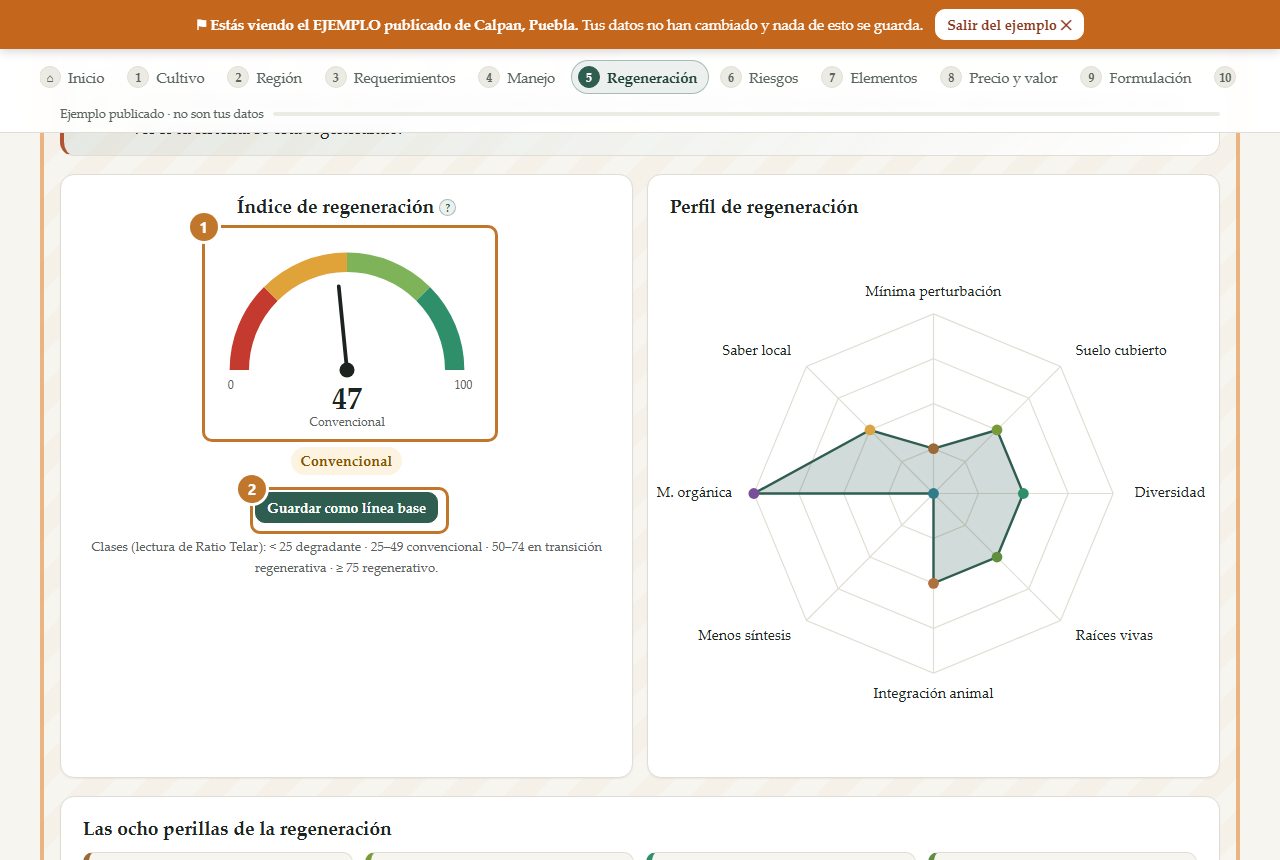
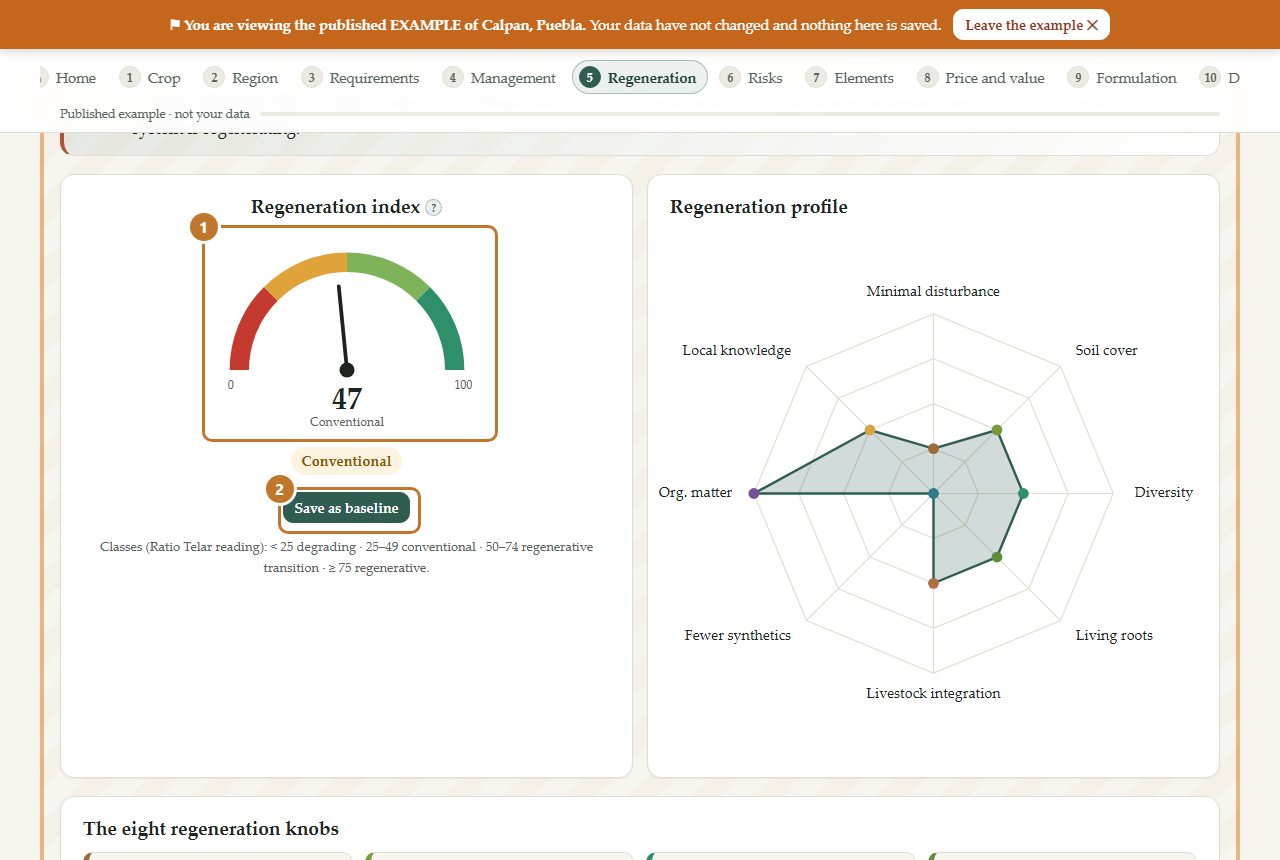
El medidor resume las ocho perillas en un número de 0 a 100 y una clase: degradante (menos de 25), convencional (25 a 49), en transición regenerativa (50 a 74) y regenerativo (75 o más). Junto está el perfil de regeneración, un radar donde se ve de un golpe qué principio está fuerte y cuál flojo.
The gauge sums up the eight knobs in a 0–100 number and a class: degrading (under 25), conventional (25–49), regenerative transition (50–74) and regenerative (75 or more). Next to it is the regeneration profile, a radar that shows at a glance which principle is strong and which weak.
- Medidor de 0 a 100, con su clase.0–100 gauge, with its class.
- Guardar como línea base.Save as baseline.
Las ocho perillasThe eight knobs
Cada perilla responde una pregunta y trae un valor sugerido calculado con tus actividades del Bloque 4, con su motivo («4 actividades de labranza practicadas»). Mientras no la confirmes se ve punteada y gris, con la leyenda «Sugerido, sin confirmar». Si el valor corresponde a tu parcela, toca Aceptar sugerencia; si es distinto, muévela. Entonces dice «✓ Confirmado por ti». Mientras falten perillas, el índice se marca como provisional. Sin actividades en el Bloque 4 no hay sugerencia: la perilla dice «sin dato».
Each knob answers one question and brings a suggested value computed from your Block 4 activities, with its reason (“4 tillage activities practised”). Until you confirm it, it looks dashed and grey, labelled “Suggested, not confirmed”. If the value fits your plot, tap Accept suggestion; if not, move it. It then reads “✓ Confirmed by you”. While knobs are missing, the index is flagged provisional. Without Block 4 activities there is no suggestion: the knob reads “no data”.
| Perilla | Knob | Pregunta | Question | Calpan | Calpan |
|---|---|---|---|---|---|
| Labranza mínima | Minimal tillage | ¿Cuántas labores mueven el suelo en cada ciclo? | How many operations move the soil each cycle? | 1 | |
| Suelo cubierto | Soil cover | ¿Cuántos meses está cubierto por cultivo, rastrojo o abono verde? | How many months is it covered by crop, stubble or green manure? | 2 | |
| Diversidad de especies | Species diversity | ¿Cuántas especies se cultivan o crían juntas? | How many species are grown or raised together? | 2 | |
| Raíces vivas | Living roots | ¿Cuántos meses hay plantas vivas en la parcela? | How many months are there living plants on the plot? | 2 | |
| Animales integrados | Animals integrated | ¿Hay animales que pastorean el rastrojo o aportan estiércol? | Are there animals grazing stubble or providing manure? | 2 | |
| Menos agroquímicos | Fewer agrochemicals | ¿Qué parte de los insumos son de síntesis frente a bioinsumos? | What share of inputs is synthetic versus bio-inputs? | 0 | |
| Materia orgánica | Organic matter | ¿Se devuelven residuos al suelo y se mide la materia orgánica? | Are residues returned to the soil and organic matter measured? | 4 | |
| Saber local | Local knowledge | ¿Qué tanto se apoya el manejo en el saber local y la semilla propia? | How much does management rely on local knowledge and own seed? | 2 |
- Labranza mínima: 1 · Bajo, porque se practican cuatro labores que mueven el suelo.Minimal tillage: 1 · Low, because four soil-moving operations are practised.
Aceptando los valores sugeridos, el índice es 47 · Convencional. Lo bajan las cuatro labores que mueven el suelo (subsoleo, arado, rastra y rastreo) y el uso de agroquímicos (16 actividades con agroquímicos y 1 con bioinsumos). Lo suben las seis actividades que devuelven residuos al suelo y el análisis de suelo. Las que más regeneran son el rastreo para incorporar materia orgánica y captar humedad, y la inspección visual; las que más desgastan, las ligadas al herbicida.
Accepting the suggested values, the index is 47 · Conventional. It is lowered by the four soil-moving operations (subsoiling, ploughing, harrowing and tilling) and by agrochemical use (16 activities with agrochemicals and 1 with bio-inputs). It is raised by the six activities returning residues to the soil and by soil testing. The most regenerating are tilling to incorporate organic matter and capture moisture, and visual inspection; the most wearing, those linked to herbicide.
Línea base y materia orgánicaBaseline and organic matter
La regeneración se ve con el tiempo. Toca Guardar como línea base hoy y vuelve en el siguiente ciclo: la app dice si el índice subió («el sistema se regenera») o bajó («el sistema se desgasta») y en qué perillas. Si tienes dos análisis de suelo, anota el % de materia orgánica de antes y de ahora: es la prueba más directa.
Regeneration shows over time. Tap Save as baseline today and come back next cycle: the app says whether the index rose (“the system is regenerating”) or fell (“the system is wearing out”) and on which knobs. If you have two soil tests, enter the % organic matter before and now: it is the most direct proof.
| Labranza en 0 o 1 | Tillage at 0 or 1 | Prueba reducir una labor o dejar rastrojo en superficie en una franja. | Try dropping one operation or leaving stubble on the surface in a strip. |
| Menos agroquímicos en 0 o 1 | Fewer agrochemicals at 0 or 1 | Sustituye una aplicación por un bioinsumo y regístrala como actividad innovadora. | Replace one application with a bio-input and record it as an innovative activity. |
| Diversidad o raíces vivas en 0 o 1 | Diversity or living roots at 0 or 1 | Una cobertera después de la cosecha o un intercalado (MIAF) suben las dos. | A cover crop after harvest or intercropping (MIAF) raises both. |
Qué puede salir mal y qué tan grave sería
What could go wrong and how serious it would be
Diecinueve riesgos en una matriz de probabilidad por impacto, reducidos por la capacidad de adaptación de tu sistema.
Nineteen risks in a likelihood-by-impact matrix, reduced by your system’s adaptive capacity.
El índice y la matrizThe index and the matrix
Arriba ves el índice de riesgo (0 a 100), la capacidad adaptativa y de qué está hecha, cuántos riesgos son altos o muy altos y cuál es el mayor. Debajo, la matriz de riesgos: cada círculo dice cuántos riesgos caen en esa celda.
At the top you see the risk index (0 to 100), the adaptive capacity and what it is made of, how many risks are high or very high, and which is the highest. Below, the risk matrix: each circle shows how many risks fall in that cell.
- Índice de riesgo y su clase.Risk index and its class.
- Matriz de probabilidad por impacto.Likelihood-by-impact matrix.
Las perillas de cada riesgoEach risk’s knobs
Los riesgos están agrupados en climáticos (sequía, helada, granizo, lluvias intensas, ola de calor, ciclones), biológicos (plagas, enfermedades, malezas), de mercado (caída del precio, alza de insumos, intermediarismo), sociales (falta de mano de obra y relevo, pérdida del saber local, inseguridad), institucionales (retiro de apoyos, tenencia de la tierra) y de recursos naturales (erosión, escasez de agua). Para cada uno: desmarca si no aplica, y mueve probabilidad, impacto y el control que ya tienes.
Risks are grouped into climatic (drought, frost, hail, heavy rain, heatwave, cyclones), biological (pests, diseases, weeds), market (price fall, input cost rise, middlemen), social (labour shortage and succession, loss of local knowledge, insecurity), institutional (support withdrawal, land tenure) and natural resources (erosion, water scarcity). For each: untick it if it does not apply, and move likelihood, impact and the control you already have.
- Probabilidad: qué tan seguido pasa (1 muy baja a 5 muy alta).Likelihood: how often it happens (1 very low to 5 very high).
- Impacto: cuánto daño hace.Impact: how much damage it does.
- Control que ya tienes: ninguno, bajo, medio o alto.Control you already have: none, low, medium or high.
- Riesgo resultante, de 0 a 25, con su nivel.Resulting risk, 0 to 25, with its level.
De tus datos y de la prospectiva. Por ejemplo, la probabilidad de sequía sube a 4 porque el escenario tendencial supone 0.2 °C de calentamiento por década (IPCC, 2018); el impacto del alza de insumos depende de qué parte de tus actividades usa insumos comprados. Lo que no se puede deducir queda en 3, «moderado: ajústalo a tu localidad».
From your data and the outlook. For example, drought likelihood rises to 4 because the trend scenario assumes 0.2 °C of warming per decade (IPCC, 2018); the impact of input cost rises depends on what share of your activities uses purchased inputs. What cannot be deduced stays at 3, “moderate: adjust it to your locality”.
Índice de riesgo 27 · Medio, con capacidad adaptativa de 70 (regeneración 47, diversificación de productos 100, acceso a conocimiento técnico 83, integración institucional 50). Los cuatro riesgos mayores empatan en 8.6 de 25: sequía o lluvias tardías, ola de calor, alza de insumos y falta de mano de obra. El Stack registra como perturbaciones El Niño y La Niña, los ciclones del Atlántico y las oscilaciones Madden-Julian y Ártica, pero no publica sus probabilidades: por eso quedan como sugerencias editables.
Risk index 27 · Medium, with adaptive capacity of 70 (regeneration 47, product diversification 100, access to technical knowledge 83, institutional integration 50). The four highest risks tie at 8.6 out of 25: drought or late rains, heatwave, input cost rise and labour shortage. The Stack records El Niño and La Niña, Atlantic cyclones and the Madden-Julian and Arctic oscillations as disturbances, but publishes no probabilities: so they stay as editable suggestions.
Quiénes y qué participan
Who and what takes part
Los hilos del telar: actores, instituciones, insumos, equipo, recursos naturales y financieros, conocimientos, políticas, perturbaciones y productos.
The loom’s threads: actors, institutions, inputs, equipment, natural and financial resources, knowledge, policies, disturbances and products.
Diez categoríasTen categories
Cada elemento pertenece a una de diez categorías y participa en una o varias actividades. La barra junto a cada uno dice en cuántas actividades aparece. En Calpan son 63 elementos tomados del artículo: por ejemplo, productores de maíz criollo, proveedores de insumos, asesores técnicos, academia local (CBTA 255), CIMMYT, semilla criolla, rastrojo, humedad del suelo, El Niño y La Niña, grano y forraje.
Each element belongs to one of ten categories and takes part in one or more activities. The bar next to each shows how many activities it appears in. In Calpan there are 63 elements taken from the paper: for example, landrace maize farmers, input suppliers, technical advisers, local academia (CBTA 255), CIMMYT, landrace seed, stubble, soil moisture, El Niño and La Niña, grain and fodder.
Si agregas «Caja de ahorro comunitaria», elígelo después en la actividad donde participa (Bloque 4, «+ Actividad innovadora» o el detalle del paso). Si no, queda en el catálogo pero no se teje.
If you add “Community savings fund”, then choose it in the activity where it takes part (Block 4, “+ Innovative activity” or the step detail). Otherwise it stays in the catalogue but is not woven in.
Elementos expuestos al riesgoElements exposed to risk
Al final del bloque, la tarjeta Regeneración y riesgo en los elementos muestra qué elementos están más expuestos: el riesgo mayor de las amenazas que los afectan (Bloque 6).
At the end of the block, the Regeneration and risk in the elements card shows which elements are most exposed: the highest risk among the hazards affecting them (Block 6).
Lo que cuesta y lo que vale
What it costs and what it is worth
El precio es lo que se paga en el mercado; el valor es la importancia del elemento para el sistema. No son lo mismo.
Price is what the market charges; value is the element’s importance to the system. They are not the same.
Precio por hectáreaPrice per hectare
Elige una categoría con las pestañas. Para cada elemento anota el precio unitario, la unidad (kg, L, jornal, ha) y la cantidad por hectárea; la app calcula el $/ha. En Recursos financieros están el costo de producción, los ingresos netos y el precio de venta: con ellos se calculan el margen del índice de Sarandón y el ingreso neto de la prospectiva.
Choose a category with the tabs. For each element enter the unit price, the unit (kg, L, day’s labour, ha) and the quantity per hectare; the app computes $/ha. Financial resources holds production cost, net income and sale price: they feed the margin in Sarandón’s index and net income in the outlook.
- Pestaña de la categoría.Category tab.
- Precio, unidad, cantidad por hectárea y las cuatro dimensiones del valor.Price, unit, quantity per hectare and the four value dimensions.
El valor en cuatro dimensionesValue in four dimensions
Califica cada elemento de 0 a 5 en valor económico, de uso, cultural y ecológico. Arriba, las perillas de pesos dicen cuánto cuenta cada dimensión. Si no calificas, la app usa el valor estructural: qué tanto participa el elemento en las actividades.
Rate each element from 0 to 5 on economic, use, cultural and ecological value. At the top, the weight knobs say how much each dimension counts. If you do not rate, the app uses the structural value: how much the element takes part in the activities.
La semilla criolla seleccionada en casa casi no tiene precio de mercado, pero su valor cultural y ecológico es alto; un herbicida puede costar más y valer menos para el sistema. Es una lectura de Ratio Telar: califícalo como lo vivan en tu localidad.
Home-selected landrace seed has almost no market price, yet high cultural and ecological value; a herbicide may cost more and be worth less to the system. It is a Ratio Telar reading: rate it as your locality lives it.
Tu catálogo en CSVYour catalogue as CSV
Con Descargar catálogo (CSV) guardas tus elementos, precios y valores en una hoja de cálculo; con Cargar catálogo (CSV) los traes a otro proyecto.
With Download catalogue (CSV) you save your elements, prices and values to a spreadsheet; with Load catalogue (CSV) you bring them into another project.
El artículo no publica precios ni costos; reporta un rendimiento de 5 a 6 t/ha. Por eso el caso usa el valor estructural y el ingreso neto aparece como «sin dato» hasta que captures tus cifras.
The paper publishes no prices or costs; it reports a yield of 5–6 t/ha. So the case uses structural value and net income shows as “no data” until you enter your figures.
Tejer el sistema
Weaving the system
Los elementos se vuelven nodos, las actividades compartidas se vuelven vínculos y el valor da el grosor de cada hilo.
Elements become nodes, shared activities become links and value sets each thread’s thickness.
El botón «Tejer el sistema»The “Weave the system” button
Toca Tejer el sistema. La app arma la red y te lleva al Tablero. Junto al botón ves cuántos nodos, vínculos y actividades tiene tu sistema y su densidad. Debajo, el modelo del sistema: el entorno (clima y perturbaciones), los agentes, el Stack de conocimiento, el manejo, los insumos, los recursos, las instituciones, las políticas y los productos, con sus flechas.
Tap Weave the system. The app builds the network and takes you to the Dashboard. Next to the button you see how many nodes, links and activities your system has and its density. Below, the system model: the environment (climate and disturbances), agents, knowledge Stack, management, inputs, resources, institutions, policies and products, with their arrows.
- Tejer el sistema; después de tejer dice «Volver a tejer el sistema».Weave the system; once woven it reads “Re-weave the system”.
Si agregas actividades, elementos o valores, regresa a este bloque y vuelve a tejer. El Tablero avisa con un recuadro ámbar si aún no has tejido.
If you add activities, elements or values, come back to this block and re-weave. The Dashboard warns with an amber box if you have not woven yet.
Leer el sistema completo
Reading the whole system
Quién sostiene el sistema, qué hilos pesan más, qué grupos se forman, quién está cerca de quién y cuándo pasa cada cosa.
Who holds the system together, which threads weigh most, which groups form, who is close to whom and when each thing happens.
El resumen de arribaThe summary at the top
Los indicadores de arriba dicen el tamaño de la red (nodos y vínculos), su densidad, el agrupamiento y el camino medio, la modularidad Q y la sostenibilidad media. Debajo, la tarjeta Regeneración y riesgo del sistema trae los índices de los bloques 5 y 6, el radar y la matriz.
The top indicators give the network size (nodes and links), its density, clustering and mean path, modularity Q and mean sustainability. Below, the System regeneration and risk card brings the indices from blocks 5 and 6, the radar and the matrix.
La red del sistemaThe system network
Cada punto es un elemento, con el color de su categoría; su tamaño depende de la medida que elijas arriba: grado ponderado (cuánto se relaciona), intermediación (cuánto sirve de puente), vector propio (si se relaciona con los importantes) o cercanía. Toca un nodo para ver solo sus relaciones. Como los productores participan en casi todo, la casilla Ocultar al nodo omnipresente deja ver la estructura interna.
Each dot is an element, coloured by category; its size depends on the measure you choose at the top: weighted degree (how related it is), betweenness (how much it bridges), eigenvector (whether it relates to the important ones) or closeness. Tap a node to see only its relations. Since farmers take part in almost everything, the Hide the omnipresent node box reveals the inner structure.
- Medida que da el tamaño de los nodos.Measure that sets node size.
- Ocultar a los productores para ver la estructura interna.Hide farmers to see the inner structure.
Con los productores, la red tiene 61 elementos y 209 vínculos, y sus grupos casi no se distinguen (Q = 0.04). Al ocultarlos aparecen siete comunidades claras (Q = 0.45): asesoría técnica y sanidad; insumos y costos; maquinaria, suelo y humedad; memoria campesina (familia, semilla criolla, saber tácito y cultural, calendario lunar); mercado; clima; y academia e instituciones. Los asesores técnicos, el conocimiento técnico y el tácito son los mayores puentes.
With farmers, the network has 61 elements and 209 links, and its groups barely show (Q = 0.04). Hiding them reveals seven clear communities (Q = 0.45): technical advice and plant health; inputs and costs; machinery, soil and moisture; farming memory (family, landrace seed, tacit and cultural knowledge, lunar calendar); market; climate; and academia and institutions. Technical advisers, technical and tacit knowledge are the biggest bridges.
Correlaciones de un elementoOne element’s correlations
Elige un elemento en la lista y verás con cuáles aparece junto en las mismas actividades (barras verdes) y con cuáles casi nunca coincide (barras rojas).
Choose an element in the list to see which ones appear together with it in the same activities (green bars) and which hardly ever coincide (red bars).
- Elemento a analizar.Element to analyse.
El cladograma: ¿quién está cerca de quién?The cladogram: who is close to whom?
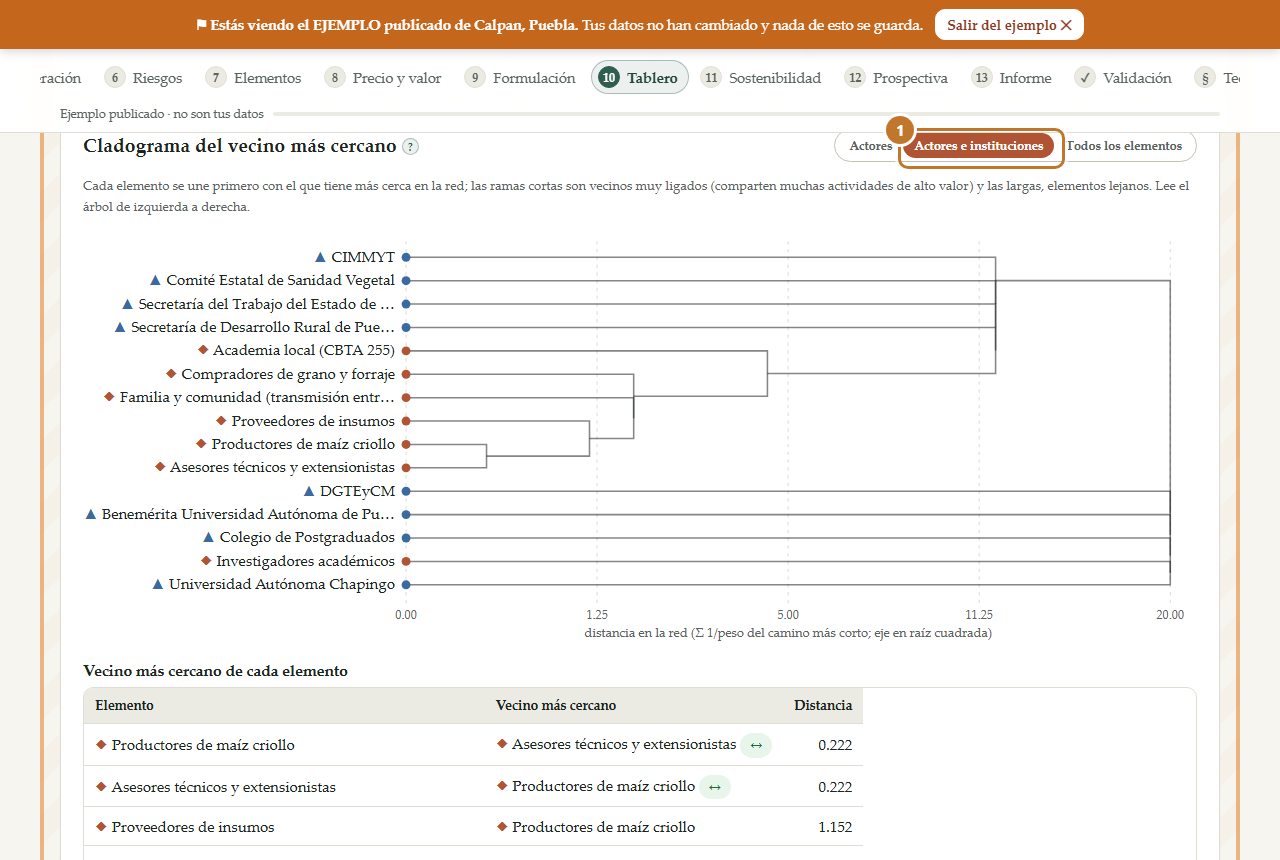
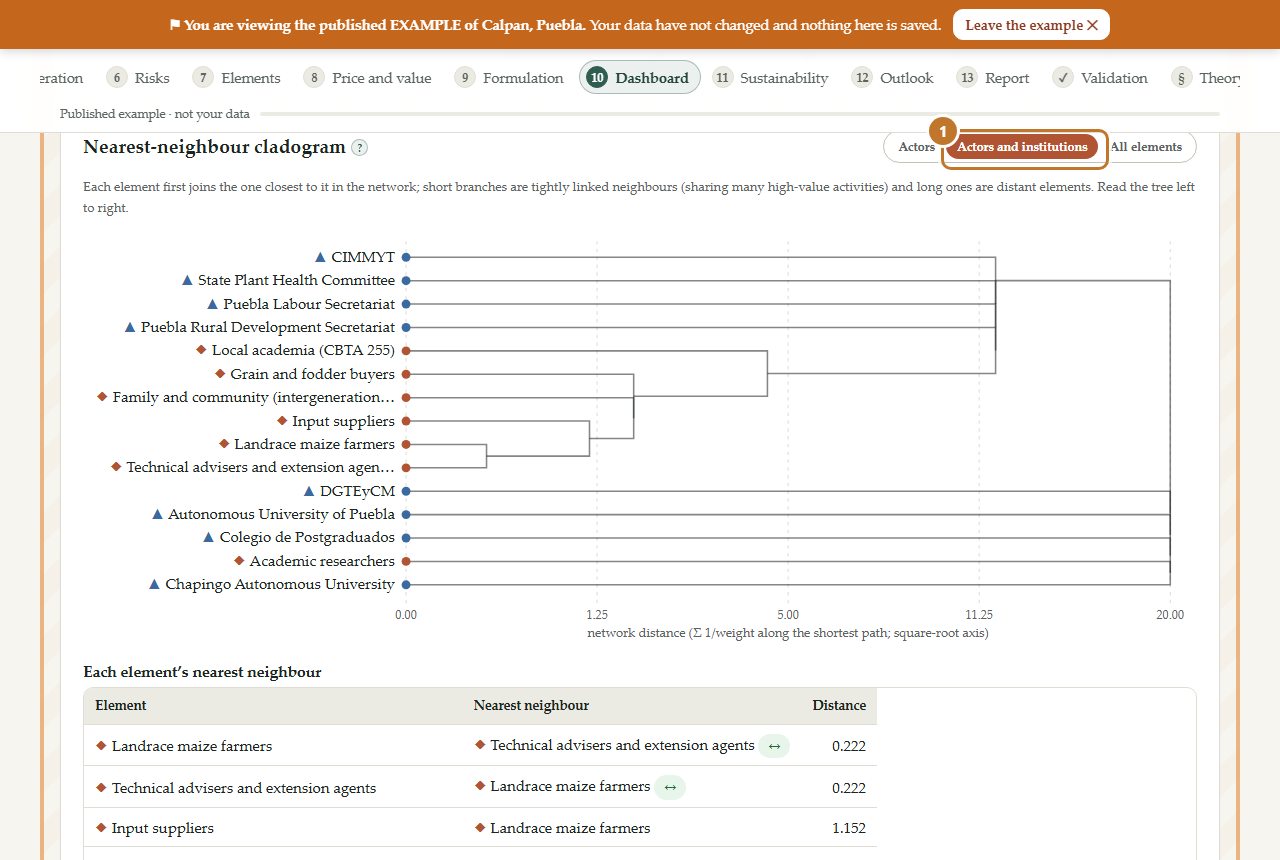
El cladograma agrupa a los elementos según su cercanía en la red: cada uno se une primero con su vecino más cercano. Lee el árbol de izquierda a derecha: las ramas cortas son elementos muy ligados, que conviene atender juntos. Elige ver solo actores, actores e instituciones, o todos los elementos. Debajo, la tabla dice el vecino más cercano de cada uno; ↔ marca a los vecinos mutuos.
The cladogram groups elements by closeness in the network: each first joins its nearest neighbour. Read the tree left to right: short branches are tightly linked elements, best looked after together. Choose to see actors only, actors and institutions, or all elements. Below, the table gives each one’s nearest neighbour; ↔ marks mutual neighbours.
- Qué elementos agrupar.Which elements to group.
Son elementos que no participan en ninguna actividad capturada: los liga solo un vínculo estructural del artículo. En Calpan son las universidades y los investigadores; si trabajan con tu localidad, agrégalos a las actividades donde participan.
These are elements that take part in no recorded activity: only a structural tie from the paper links them. In Calpan they are the universities and researchers; if they work with your locality, add them to the activities they take part in.
El calendario circularThe circular calendar
El año es un círculo; cada anillo es un tipo de actividad y cada arco, un paso con sus fechas. La aguja marca hoy y el centro anuncia la siguiente actividad. Toca un arco para abrir su paso en el Bloque 4; en la leyenda, para filtrar.
The year is a circle; each ring is an activity type and each arc a step with its dates. The needle marks today and the centre announces the next activity. Tap an arc to open its step in Block 4; tap the legend to filter.
Suelo, agua, ODS y huella
Soil, water, SDGs and footprint
Cada actividad deja una marca. Aquí ves cuáles suman, cuáles restan, el índice de Sarandón, los 17 ODS y la huella de carbono.
Every activity leaves a mark. Here you see which add, which subtract, Sarandón’s index, the 17 SDGs and the carbon footprint.
Índice de sostenibilidad y SarandónSustainability index and Sarandón
El índice de sostenibilidad (IS) va de 0 a 1: 0.5 es neutro, arriba la actividad suma y abajo resta. El índice general de sostenibilidad de Sarandón (ISGen) promedia tres dimensiones en escala de 0 a 4: económica (IK), ecológica (IE) y sociocultural (ISC). El sistema es sostenible si ISGen es mayor que 2 y ninguna dimensión queda por debajo de 2.
The sustainability index (IS) goes from 0 to 1: 0.5 is neutral, above it the activity adds and below it subtracts. Sarandón’s general sustainability index (ISGen) averages three dimensions on a 0–4 scale: economic (IK), ecological (IE) and socio-cultural (ISC). The system is sustainable if ISGen is above 2 and no dimension falls below 2.
Los 17 ODSThe 17 SDGs
La rueda y las tarjetas muestran el grado de cumplimiento de cada Objetivo de Desarrollo Sostenible con evidencia de tu sistema. «Sin dato» no es incumplimiento: significa que tus datos no dicen nada de ese objetivo.
The wheel and cards show how far each Sustainable Development Goal is met with evidence from your system. “No data” is not failure: it means your data says nothing about that goal.
Huella de carbonoCarbon footprint
Captura los litros de diésel, los kilos de nitrógeno y de urea por hectárea y el rendimiento: la app calcula los kilos de CO₂ equivalente por hectárea y por tonelada con los factores del IPCC. Si dejas los campos vacíos, la huella aparece como «—».
Enter litres of diesel, kilos of nitrogen and urea per hectare and the yield: the app computes kilos of CO₂ equivalent per hectare and per tonne with IPCC factors. If you leave the fields empty, the footprint shows as “—”.
El IS medio de las actividades es 0.51, casi neutro. Las que más restan están ligadas al herbicida y a la mezcla de agroquímicos; las que más suman, a la inspección, el rastreo para incorporar materia orgánica y las decisiones con información. Las fuentes no publican diésel ni nitrógeno por hectárea en Calpan, así que la huella espera tus datos.
The activities’ mean IS is 0.51, almost neutral. Those subtracting most are linked to herbicide and agrochemical mixing; those adding most, to inspection, tilling to incorporate organic matter and informed decisions. The sources publish no diesel or nitrogen per hectare for Calpan, so the footprint awaits your data.
Tres futuros a 2, 5 y 10 años
Three futures at 2, 5 and 10 years
No son pronósticos: son escenarios para conversar con la familia, los asesores y la comunidad sobre qué hacer hoy.
They are not forecasts: they are scenarios to discuss with the family, advisers and community what to do today.
Deseable, tendencial y no deseadoDesirable, trend and undesired
Cada escenario combina el precio del producto, el costo de los insumos, el calentamiento, la frecuencia de años extremos, la mano de obra familiar disponible y la adopción de tus actividades innovadas. La app grafica diez indicadores con marcas en los años 2, 5 y 10: rendimiento, precio, costo, ingreso bruto ÷ costo, ingreso neto, mano de obra, adopción, sostenibilidad, regeneración y riesgo. Debajo, las potencialidades y las perspectivas no deseadas se escriben solas con tus resultados.
Each scenario combines product price, input cost, warming, frequency of extreme years, available family labour and adoption of your innovated activities. The app plots ten indicators marked at years 2, 5 and 10: yield, price, cost, gross income ÷ cost, net income, labour, adoption, sustainability, regeneration and risk. Below, the potentials and undesired prospects are written from your results.
Con los supuestos iniciales y hoy = 100, a 10 años la relación ingreso bruto ÷ costo queda en 96 (deseable), 74 (tendencial) y 48 (no deseado); el rendimiento, en 96, 90 y 82; la mano de obra familiar disponible, en 95, 86 y 74. Como el caso aún no tiene actividades innovadas, la adopción no cambia los resultados: agrégalas en el Bloque 4 para ver su potencial.
With the default assumptions and today = 100, at 10 years the gross income ÷ cost ratio is 96 (desirable), 74 (trend) and 48 (undesired); yield, 96, 90 and 82; available family labour, 95, 86 and 74. Since the case has no innovated activities yet, adoption does not change the results: add them in Block 4 to see their potential.
Los supuestosThe assumptions
La tabla de supuestos es editable. Lo que tiene base publicada lleva su fuente (calentamiento, IPCC 2018; pérdida de rendimiento por grado, Zhao y colaboradores 2017; curva de adopción, Rogers 2003); el resto lleva la etiqueta ◆ de supuesto. Contrasta precios y mano de obra con el Censo Agropecuario y la ENOE del INEGI y con los precios del SIAP de tu municipio.
The assumptions table is editable. What has a published basis carries its source (warming, IPCC 2018; yield loss per degree, Zhao and colleagues 2017; adoption curve, Rogers 2003); the rest is flagged ◆ as an assumption. Check prices and labour against INEGI’s Agricultural Census and ENOE and SIAP prices for your municipality.
- Cada fila es un supuesto; cada columna, un escenario.Each row is an assumption; each column, a scenario.
- Volver a los valores iniciales.Reset to defaults.
Todo tu sistema en un documento
Your whole system in one document
Resumen redactado, territorio, calendario, elementos clave, cladograma, regeneración, riesgos, prospectiva y ODS, listo para imprimir.
Written summary, territory, calendar, key elements, cladogram, regeneration, risks, outlook and SDGs, ready to print.
Imprimir, exportar y guardarPrint, export and save
- Imprimir o guardar PDF: en el cuadro de impresión elige «Guardar como PDF». La impresión sigue la vista activa.Print or save PDF: in the print dialog choose “Save as PDF”. Printing follows the active view.
- Guardar proyecto: un archivo .json con todo lo que capturaste.Save project: a .json file with everything you entered.
- Abrir proyecto: carga un archivo guardado.Open project: loads a saved file.
Los botones de CSV descargan las tablas de actividades, nodos, vínculos, calendario, ODS y cladograma para trabajarlas en una hoja de cálculo. Empezar de nuevo borra el proyecto de este navegador: guárdalo antes.
The CSV buttons download the activities, nodes, links, calendar, SDG and cladogram tables for use in a spreadsheet. Start over erases the project from this browser: save it first.
Al imprimir, la app usa siempre el tema claro, despliega el marco teórico, quita las animaciones y ajusta las tablas al ancho de la hoja, aunque estés en modo noche.
When printing, the app always uses the light theme, expands the theory, drops animations and fits tables to the page width, even in night mode.
Documentar un cultivo nuevo
Documenting a new crop
La ruta completa para tejer un cultivo que aún no tiene Stack, como la uva de Mata de Zarza o el agave del bacanora en Sonora.
The full route to weave a crop that has no Stack yet, such as Mata de Zarza grapes or the bacanora agave in Sonora.
Diez pasosTen steps
- Reúne a la gente. Productores con experiencia, quien hereda la parcela, el asesor técnico. El Stack de Calpan se armó con 100 informantes en tres ciclos.
- Bring people together. Experienced farmers, whoever will inherit the plot, the technical adviser. Calpan’s Stack was built with 100 informants over three cycles.
- Bloque 1. Elige el cultivo (o agrégalo), su variedad y el sistema; anota la superficie.
- Block 1. Choose the crop (or add it), its variety and system; enter the area.
- Bloque 2. Ubica la localidad.
- Block 2. Locate the locality.
- Bloque 3. Pregunta: «¿qué se necesita para que este cultivo salga bien?». Agrupa las respuestas en pocas reglas, como las 5B.
- Block 3. Ask: “what does this crop need to do well?”. Group the answers into a few rules, like the 5B.
- Bloque 4. Lista los pasos del ciclo en orden, las actividades de cada paso, quién participa y las fechas principales.
- Block 4. List the cycle’s steps in order, each step’s activities, who takes part and the main dates.
- Bloques 5 y 6. Ajusta las perillas de regeneración y de riesgo con lo que vive la localidad; guarda la línea base.
- Blocks 5 and 6. Adjust the regeneration and risk knobs to what the locality lives; save the baseline.
- Bloque 7. Revisa que estén todos los elementos; agrega los que falten y elígelos en sus actividades.
- Block 7. Check all elements are there; add the missing ones and choose them in their activities.
- Bloque 8. Anota precios, costos e ingresos por hectárea y califica el valor.
- Block 8. Enter prices, costs and income per hectare and rate value.
- Bloque 9. Teje el sistema y léelo en los bloques 10 a 12 con la gente que lo vive.
- Block 9. Weave the system and read it in blocks 10–12 with the people who live it.
- Bloque 13. Imprime el informe, guarda el proyecto y regresa en el siguiente ciclo.
- Block 13. Print the report, save the project and come back next cycle.
Un proyecto bien documentado de una localidad es el primer paso para publicar su Stack, como se hizo en Calpan. Guarda las fuentes de cada dato.
A well-documented project from a locality is the first step to publishing its Stack, as was done in Calpan. Keep the sources of every figure.
Guía de entrevista, bloque por bloqueInterview guide, block by block
Preguntas abiertas para una plática con productores. No hace falta seguir el orden; lo importante es que cada respuesta quede anotada con quién la dijo y cuándo.
Open questions for a conversation with farmers. The order is not important; what matters is that every answer is written down with who said it and when.
| Bloque | Block | Preguntas | Questions |
|---|---|---|---|
| 1 | ¿Qué siembran o crían? ¿Qué variedad o raza, y de dónde viene la semilla o el pie de cría? ¿Siembran solo o asociado? ¿Cuántas hectáreas, colmenas o cabezas? | What do you grow or raise? Which variety or breed, and where do the seed or breeding stock come from? Sole crop or intercropped? How many hectares, hives or head? | |
| 2 | ¿En qué localidad y municipio está la parcela? ¿Hay riego o es de temporal? | In which locality and municipality is the plot? Irrigated or rainfed? | |
| 3 | ¿Qué necesita este cultivo para que salga bien? ¿Qué cosas nunca se deben hacer? ¿Qué han cambiado en los últimos años y por qué? | What does this crop need to do well? What must never be done? What have you changed in recent years and why? | |
| 4 | ¿Cuáles son los pasos del ciclo, del primero al último? ¿Qué se hace en cada uno, con qué herramientas y quién lo hace? ¿En qué meses? | What are the cycle’s steps, first to last? What is done in each, with which tools and by whom? In which months? | |
| 5 | ¿Cuántas veces mueven la tierra? ¿Queda cubierta todo el año? ¿Dejan el rastrojo? ¿Usan abono o estiércol? ¿Hay animales en la parcela? ¿Han analizado el suelo? | How many times is the soil worked? Is it covered all year? Is stubble left? Manure or compost? Animals on the plot? Has the soil been tested? | |
| 6 | ¿Qué fue lo peor que les pasó en los últimos diez años? ¿Cada cuánto pasa? ¿Cuánto perdieron? ¿Qué hacen para evitarlo? | What was the worst thing that happened in the last ten years? How often does it happen? How much was lost? What do you do to prevent it? | |
| 7 | ¿Quién más participa: familia, jornaleros, asesores, compradores, programas, instituciones? | Who else takes part: family, day labourers, advisers, buyers, programmes, institutions? | |
| 8 | ¿Cuánto les cuesta producir una hectárea y cuánto les pagan? ¿Qué vale este elemento para ustedes, además del dinero? | How much does a hectare cost to produce and what are you paid? What is this element worth to you, beyond money? | |
| 12 | ¿Quién va a sembrar dentro de diez años? ¿Qué les gustaría que cambiara y qué no? | Who will be farming in ten years? What would you like to change and what not? |
Explica para qué se usarán los datos y pide permiso antes de anotar nombres. En el informe basta con la localidad y el número de informantes.
Explain what the data will be used for and ask permission before writing down names. In the report the locality and the number of informants are enough.
Hoja de campo 1: pasos y actividadesField sheet 1: steps and activities
Imprime esta página y llénala a mano en la parcela; luego pásala al Bloque 4.
Print this page and fill it in by hand on the plot; then transfer it to Block 4.
Cultivo o especie: ______________________ Localidad: ______________________ Fecha: ___________
Crop or species: ______________________ Locality: ______________________ Date: ___________
| # | Paso | Step | Actividad | Activity | Quién · con qué | Who · with what | Mes | Month | T / I | T / I |
|---|---|---|---|---|---|---|---|---|---|---|
| 1 | ||||||||||
| 2 | ||||||||||
| 3 | ||||||||||
| 4 | ||||||||||
| 5 | ||||||||||
| 6 | ||||||||||
| 7 | ||||||||||
| 8 | ||||||||||
| 9 | ||||||||||
| 10 | ||||||||||
| 11 | ||||||||||
| 12 | ||||||||||
| 13 | ||||||||||
| 14 | ||||||||||
| 15 | ||||||||||
| 16 | ||||||||||
| 17 | ||||||||||
| 18 |
T = tradicional, I = innovada.
T = traditional, I = innovated.
Hoja de campo 2: regeneraciónField sheet 2: regeneration
Marca con la gente un número del 0 al 4 en cada fila y anota por qué; luego pásalo a las perillas del Bloque 5.
Mark a number from 0 to 4 on each row with the people and write why; then transfer it to the Block 5 knobs.
| Indicador | Indicator | 0 | 1 | 2 | 3 | 4 | ¿Por qué? | Why? |
|---|---|---|---|---|---|---|---|---|
| Labranza mínima | Minimal tillage | ○ | ○ | ○ | ○ | ○ | ||
| Suelo cubierto | Soil cover | ○ | ○ | ○ | ○ | ○ | ||
| Diversidad | Diversity | ○ | ○ | ○ | ○ | ○ | ||
| Raíces vivas | Living roots | ○ | ○ | ○ | ○ | ○ | ||
| Integración animal | Livestock integration | ○ | ○ | ○ | ○ | ○ | ||
| Menos insumos de síntesis | Fewer synthetic inputs | ○ | ○ | ○ | ○ | ○ | ||
| Materia orgánica | Organic matter | ○ | ○ | ○ | ○ | ○ | ||
| Saber local | Local knowledge | ○ | ○ | ○ | ○ | ○ |
Suma: ______ ÷ 32 = IR ______ Materia orgánica del análisis de suelo: ______ % Año: ______
Sum: ______ ÷ 32 = IR ______ Organic matter from soil test: ______ % Year: ______
Hoja de campo 3: riesgosField sheet 3: risks
Para cada amenaza: probabilidad (1 rara vez … 5 casi cada año), impacto (1 casi nada … 5 se pierde todo) y control (0 nada … 3 bien controlado). Tacha las que no aplican.
For each hazard: likelihood (1 rarely … 5 almost every year), impact (1 almost nothing … 5 everything lost) and control (0 none … 3 well controlled). Cross out those that do not apply.
| Amenaza | Hazard | Prob. | Lik. | Impacto | Impact | Control | Qué hacemos | What we do |
|---|---|---|---|---|---|---|---|---|
| Sequía o lluvias tardías | Drought or late rains | |||||||
| Helada | Frost | |||||||
| Granizo | Hail | |||||||
| Lluvias intensas o inundación | Heavy rain or flooding | |||||||
| Ola de calor | Heatwave | |||||||
| Ciclones y huracanes | Cyclones and hurricanes | |||||||
| Plagas | Pests | |||||||
| Enfermedades | Diseases | |||||||
| Malezas resistentes o invasoras | Resistant or invasive weeds | |||||||
| Caída del precio de venta | Fall in sale price | |||||||
| Alza de insumos y servicios | Rise in input and service costs | |||||||
| Intermediarismo o falta de comprador | Middlemen or no buyer | |||||||
| Falta de mano de obra y de relevo | Labour shortage and no succession | |||||||
| Pérdida del saber local | Loss of local knowledge | |||||||
| Inseguridad o robo | Insecurity or theft | |||||||
| Retiro de programas y apoyos | Withdrawal of programmes and support | |||||||
| Conflictos de tenencia de la tierra | Land tenure conflicts | |||||||
| Erosión y pérdida de fertilidad | Erosion and fertility loss | |||||||
| Escasez de agua | Water scarcity |
Hoja de campo 4: costos, precio y valorField sheet 4: costs, price and value
Por hectárea (o por colmena, o por cabeza) y por ciclo. Luego pásalo al Bloque 8.
Per hectare (or per hive, or per head) and per cycle. Then transfer it to Block 8.
| Concepto | Item | Cantidad | Quantity | Precio unitario | Unit price | $ |
|---|---|---|---|---|---|---|
| Semilla o pie de cría | Seed or breeding stock | |||||
| Fertilizantes y abonos | Fertilisers and manure | |||||
| Plaguicidas y herbicidas | Pesticides and herbicides | |||||
| Maquinaria y diésel (litros) | Machinery and diesel (litres) | |||||
| Jornales (familiares y pagados) | Labour days (family and paid) | |||||
| Agua, renta, flete, otros | Water, rent, freight, other | |||||
| Costo total | Total cost | |||||
| Producción vendida | Production sold | |||||
| Autoconsumo y subproductos (rastrojo, totomoxtle…) | Own use and by-products (stubble, husks…) | |||||
| Ingreso total | Total income |
Valor de los elementos principales, del 0 al 5:
Value of the main elements, from 0 to 5:
| Elemento | Element | Económico | Economic | De uso | Use | Cultural | Ecológico | Ecological |
|---|---|---|---|---|---|---|---|---|
Problemas frecuentes
Troubleshooting
Si algo no se ve como esperas, busca aquí.
If something does not look as you expect, look here.
| Veo esto | I see this | Haz esto | Do this |
|---|---|---|---|
| El Tablero dice «Aún no tejes el sistema». | The Dashboard says “You have not woven the system yet”. | Ve al Bloque 9 y toca Tejer el sistema. | Go to Block 9 and tap Weave the system. |
| Mi cultivo nuevo no tiene red. | My new crop has no network. | Agrega pasos y actividades en el Bloque 4 y elige sus elementos; sin actividades no hay vínculos. | Add steps and activities in Block 4 and choose their elements; no activities, no links. |
| Un elemento que agregué no aparece en la red. | An element I added is not in the network. | Elígelo en al menos una actividad. | Choose it in at least one activity. |
| El ingreso neto dice «sin dato». | Net income says “no data”. | Captura el ingreso y el costo por hectárea en Bloque 8›Recursos financieros. | Enter income and cost per hectare in Block 8›Financial resources. |
| La huella de carbono dice «—». | The carbon footprint says “—”. | Captura diésel, nitrógeno, urea y rendimiento en el Bloque 11. | Enter diesel, nitrogen, urea and yield in Block 11. |
| La adopción de innovaciones queda en 0 %. | Innovation adoption stays at 0 %. | Agrega actividades innovadoras en el Bloque 4. | Add innovative activities in Block 4. |
| Cambié de computadora y no están mis datos. | I changed computer and my data is gone. | Los datos viven en cada navegador: usa Informe›Guardar proyecto y Abrir proyecto. | Data lives in each browser: use Report›Save project and Open project. |
| No veo los cambios de una nueva versión. | I do not see a new version’s changes. | Recarga con Ctrl + F5. | Reload with Ctrl + F5. |
Glosario
Glossary
Las palabras de la app, en lenguaje sencillo.
The app’s words, in plain language.
Ratio Telar en una página
Ratio Telar on one page
Recórtala y llévala a la parcela.
Cut it out and take it to the field.
- 1CultivoCropElige el cultivo o la especie, su variedad o raza y el sistema de producción.Choose the crop or species, its variety or breed and the production system.
- 2RegiónRegionUbica tu parcela hasta la localidad del INEGI.Locate your plot down to the INEGI locality.
- 3RequerimientosRequirementsRevisa las 5B y agrega lo que tu localidad ha innovado.Review the 5B and add what your locality has innovated.
- 4ManejoManagementMarca lo que practicas, agrega innovaciones y pon fechas.Tick what you practise, add innovations and set dates.
- 5RegeneraciónRegenerationAjusta las ocho perillas y guarda una línea base.Adjust the eight knobs and save a baseline.
- 6RiesgosRisksMueve probabilidad, impacto y control de cada riesgo.Move likelihood, impact and control for each risk.
- 7ElementosElementsRevisa actores, insumos y recursos; agrega los que falten.Review actors, inputs and resources; add the missing ones.
- 8Precio y valorPrice and valueAnota precios por hectárea y califica el valor de 0 a 5.Enter prices per hectare and rate value from 0 to 5.
- 9FormulaciónFormulation⚙ Formular: la app teje la red del sistema.⚙ Formulate: the app weaves the system network.
- 10TableroDashboardLee quién sostiene el sistema y quién está cerca de quién.Read who holds the system together and who is close to whom.
- 11SostenibilidadSustainabilityRevisa qué suma, qué resta y el índice de Sarandón.See what adds, what subtracts and Sarandón’s index.
- 12ProspectivaOutlookCompara los tres futuros y ajusta los supuestos.Compare the three futures and adjust the assumptions.
- 13InformeReportImprime, exporta y guarda el proyecto.Print, export and save the project.
Escanea para abrir Ratio Telar:
hectortecumshe-ai.github.io/RatioTelar
Scan to open Ratio Telar:
hectortecumshe-ai.github.io/RatioTelar
Cómo citar, fuentes y créditos
How to cite, sources and credits
Cómo citarHow to cite
Mojica-Zárate, H. T., Díaz-José, O., Barrera-Guzmán, L. A., y Velázquez-Vázquez, G. (2026). Ratio Telar: el conocimiento agrícola local como sistema complejo adaptativo (Versión 0.5.0) [Software]. Zenodo. https://doi.org/10.5281/zenodo.23290103
Mojica-Zárate, H. T., Díaz-José, O., Barrera-Guzmán, L. A., & Velázquez-Vázquez, G. (2026). Ratio Telar: local farming knowledge as a complex adaptive system (Version 0.5.0) [Software]. Zenodo. https://doi.org/10.5281/zenodo.23290103
Fuentes principalesMain sources
- Díaz-José O, Mojica-Zárate HT, Díaz-José J, Vilaboa-Arróniz J. 2026. El conocimiento agrícola local: el stack del maíz criollo en Calpan, Puebla. Agricultura, Sociedad y Desarrollo 23(3). https://doi.org/10.22231/asyd.v23i3.1822
- Mojica Zárate HT. 2017. Modelo y procedimiento para la gestión estratégica integrada de los recursos naturales en territorios áridos con orientación agroproductiva. Tesis doctoral, Universidad Central «Marta Abreu» de Las Villas.
- CONABIO. 2020. Razas de maíz de México. · INEGI. 2020. Censo de Población y Vivienda; Catálogo Único de Claves Geoestadísticas.
- Sarandón SJ. 2002. El desarrollo y uso de indicadores para evaluar la sustentabilidad de los agroecosistemas. En: Sarandón SJ (ed.), Agroecología: el camino hacia una agricultura sustentable. Ediciones Científicas Americanas, La Plata: 393–414.
- Newton P, et al. 2020. What is regenerative agriculture? Frontiers in Sustainable Food Systems 4: 577723. · Schreefel L, et al. 2020. Regenerative agriculture – the soil is the base. Global Food Security 26: 100404.
- IPCC. 2014. Climate Change 2014: Impacts, Adaptation, and Vulnerability (SPM). · IPCC. 2018. Global Warming of 1.5 °C (SPM). · ISO 31000:2018 · IEC 31010:2019.
- Zhao C, et al. 2017. Temperature increase reduces global yields of major crops in four independent estimates. PNAS 114(35): 9326–9331. · Rogers EM. 2003. Diffusion of innovations, 5.ª ed.
Página legalLegal page
Ratio Telar · Instructivo del Productor · 2.ª edición, octubre de 2026 · describe Ratio Telar 0.5.0.
Ratio Telar · Producer Guide · 2nd edition, October 2026 · covers Ratio Telar 0.5.0.
Héctor Tecumshé Mojica-Zárate · Óscar Díaz-José · Luis Ángel Barrera-Guzmán · Guadalupe Velázquez-Vázquez
Centro Académico Regional Sede Huatusco, Universidad Autónoma Chapingo (Héctor Tecumshé Mojica-Zárate, Óscar Díaz-José, Luis Ángel Barrera-Guzmán) · Benemérita Universidad Autónoma de Puebla (Guadalupe Velázquez-Vázquez), México. ORCID del autor de correspondencia: 0000-0002-9067-3983.
Huatusco Regional Academic Centre, Chapingo Autonomous University (Héctor Tecumshé Mojica-Zárate, Óscar Díaz-José, Luis Ángel Barrera-Guzmán) · Meritorious Autonomous University of Puebla (Guadalupe Velázquez-Vázquez), Mexico. Corresponding author ORCID: 0000-0002-9067-3983.
ISBN: en trámite ante el INDAUTORISBN: application in progress (INDAUTOR, Mexico)
DOI de este instructivo: 10.5281/zenodo.23433185 · DOI de la aplicación: 10.5281/zenodo.23290103DOI of this guide: 10.5281/zenodo.23433185 · DOI of the app: 10.5281/zenodo.23290103
Texto y figuras bajo licencia Creative Commons Atribución 4.0 Internacional (CC BY 4.0); la aplicación, bajo licencia MIT. Puedes copiar, adaptar y compartir este instructivo citando a sus autores. Las capturas de pantalla son de la aplicación Ratio Telar 0.5.0. Composición tipográfica en Palatino Linotype.
Text and figures under the Creative Commons Attribution 4.0 International licence (CC BY 4.0); the app under the MIT licence. You may copy, adapt and share this guide crediting its authors. Screenshots are from the Ratio Telar 0.5.0 app. Typeset in Palatino Linotype.